

Fervo Energy: Big Tech's Clean Energy Bet Is Unraveling — Hidden Setbacks, A Litany Of Existential Issues & A Commercial Build Out Destined For Failure
Summary
- Fervo Energy (NASDAQ:FRVO) is a $4 billion startup focused on a next-generation form of geothermal energy called Enhanced Geothermal Systems (“EGS”). Considered the holy grail of geothermal, EGS promises vast amounts of low-cost clean energy, but commercial viability has eluded the industry due to seemingly unsolvable technical barriers and immense costs that have buried a half a century of attempts.
- Armed with 2 years of operating data from its pilot plant, Fervo claims it has finally cracked the code on EGS with an approach that is fully derisked, cost-competitive, and “proven at scale.” In May, it raised $2.2 billion to fund its first commercial site in Utah, known as “Cape Station.” It has already signed 1,000+ MW of offtake agreements with the likes of Google, Shell Energy, and Southern California Edison.
- Our investigation, involving interviews with former employees and a review of data obtained from state regulators, reveals that Fervo has failed to disclose existential issues related to inconsistent production temperatures and premature thermal decline, excessive water loss, seismicity-related equipment damage, transmission capacity, and ballooning costs. In some cases, Fervo appears to have presented altered data and made material misstatements to investors, including in its IPO registration statement filed with the SEC.
- Fervo’s playbook seems to be an open secret among individuals who have worked there, one of whom told us: “How does the investment community keep buying the hype? Like at what point do they stop ignoring the facts and the technical skepticisms and the challenges here?” Another former employee said the company is “intentionally concealing” the “bad things” while a third said it is “shocking and surprising” that people are taking Fervo’s claims as “gospel.”
- In one key example, Fervo claimed it achieved consistent production temperatures over 10+ months of pilot plant operations, ostensibly conquering a key hurdle of EGS. The data presented by Fervo, however, is inconsistent with the full data set we obtained from the State of Nevada. Fervo’s data does not include extreme fluctuations that are readily apparent in the full data set.
- We believe Fervo’s presentation of the data conceals the devastating results of an apparent attempt to boost production at its underperforming pilot plant during its first year. In March 2024, Fervo injected 33% more water at the pilot, but water lost to the subsurface system more than doubled to 57% and production temperatures plummeted by 90°F, only recovering when injection rates were curtailed. Fervo never disclosed those results, and CEO Tim Latimer later claimed that the pilot plant "achieved all the technical objectives” and that the company “saw no evidence of production decline” during its first year.
- Fast forward to 2026: After 2 years of testing, Fervo touted the pilot plant as a major success, despite it missing virtually every stated performance target and operating at just ~41% of its forecasted capacity, according to Fervo’s own predictions and later-published results.
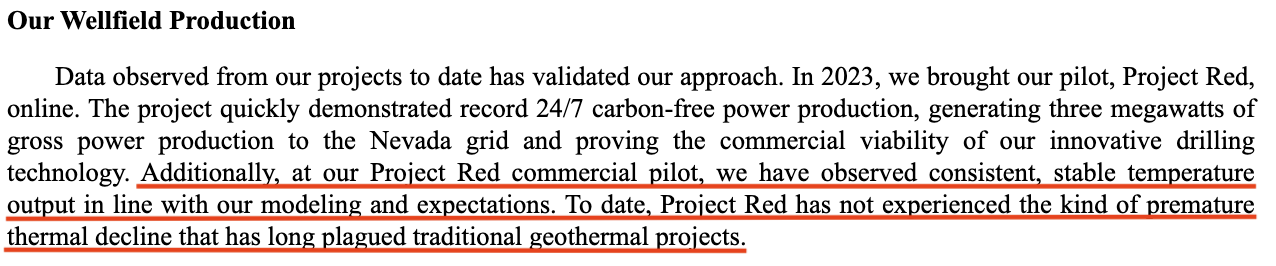
- Once again, Fervo highlighted “stable production temperatures” but conceded a “slight temperature decrease” only in the final months of testing, while still claiming in its IPO registration statement that the pilot plant “has not experienced the kind of premature thermal decline that has long plagued traditional geothermal projects.” Despite this claim, data from the State of Nevada shows that thermal decline at the pilot plant has now accelerated to 24°F per year — nearly 16x what experts told us was economically-viable for EGS projects.
- Another challenge with Fervo’s pilot plant was water loss, with a 2023 flow test showing that 10-20% of injected water did not return to the surface. CEO Latimer framed this as good news and claimed water loss rates would “only decline from there.” Instead, water loss doubled to ~30%, which Fervo falsely claimed it had predicted. Experts told us this level of water loss was far too high for commercial viability, and Fervo’s commercial aspirations rely on a more than ~30x improvement in water losses.
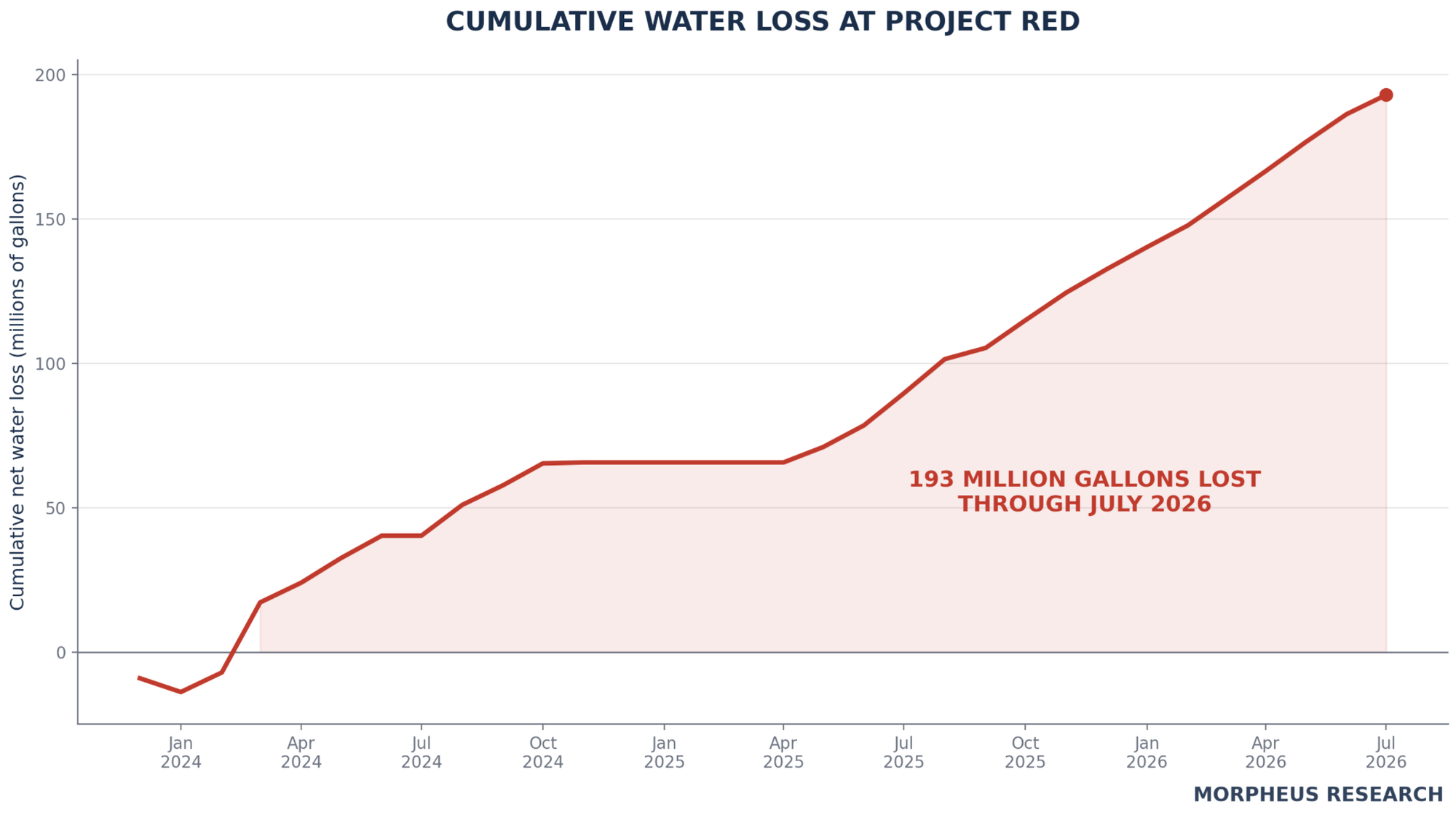
- Fervo claims the pilot plant’s water loss was “temporary” as the underlying reservoir “pressurizes,” but former employees were skeptical of this, describing it as a “hypothesis” for which there is “very little data.” Further, data we obtained from the State of Nevada reveals that the pressurization theory has not yet worked in the real world, with June 2026 water losses climbing to 35%. As of July, the pilot plant system had lost a total of ~193 million gallons to subsurface leak-off.
- Fervo believes that the pilot plant’s issues – inconsistent production temperatures, excessive water losses, premature thermal decline, and severe underperformance – will somehow disappear at its commercial-scale site but has provided little evidence for this aside from simulations. An EGS expert told us: “As with everything, they’re very aggressive in saying, ‘this is what we can get to’ … without demonstration of how they’re going to get there … anything is possible in simulation.”
- Fervo has run at least two real “flow tests” at Cape Station that would provide investors with critical viability data related to water loss, net power generation, and production temperatures. Despite incessantly preaching “radical transparency” as a core value, Fervo has opted to withhold most of this test data from investors. An EGS expert told us: “A lot of details are missing … the pressure, the circulation rate – what’s the water loss? They have done some circulation [testing], but they do not report the water loss … They did not release their data.”
- A former employee told us the Cape Station test results were deeply problematic: “The production could not be held consistent, and so they were worried that if they show the data, that will put a lot of questions in the market in terms of viability…” They told us: “I can tell you the water loss rate was not what … what they were hoping. It was much worse than what they wanted to see.” A second former employee corroborated this, stating flatly: “The producers [wells] … aren’t returning a lot of water. The water’s staying down there.”
- Putting the costs of excessive water loss aside, we believe investors are severely underestimating the risk of Fervo losing access to water altogether. The drought-stricken State of Utah only granted water to Fervo based on a “non-consumptive” designation. This relies on Fervo’s claim that, even if substantial volumes of water are lost in the system, the fluid will “eventually” migrate through 6,000 feet of granite back to “recharge” the source aquifer, ostensibly making Fervo’s water use effectively zero-loss.
- Industry experts and former Fervo employees were immensely skeptical of the “recharge” argument. For example, a former Fervo employee told us: “That’s just not how mother nature works” and an EGS expert told us: “That is the rosiest picture they could present to [Utah Regulators].” Finally, energy analytics firm Enverus wrote that the water could take “tens of thousands” of years to migrate back and that Fervo “could face challenges to the non-consumptive classification…”
- Another risk that Fervo has downplayed is related to earthquakes, known in the fracking industry as “induced seismicity.” According to industry experts, EGS water injection can induce seismic activity that severely exacerbates water loss, damages well infrastructure, and in some cases causes full-blown earthquakes, crushing project economics or leading to complete project shutdowns after CapEx has already been deployed.
- CEO Latimer claims seismicity is a “perception issue” and that Fervo has only had “several” yellow-level (M2+ Richter Scale) seismic events over 4 years of operations. Fervo’s own seismic catalogue, however, reveals ~58 yellow events as of the end of April, which are rapidly accelerating in frequency and intensity. 29 of these events happened in March and April alone – more than the previous 2 years combined. This spike seems to have overlapped with Fervo’s fracking activities at its “Frisco” well pad, which CEO Latimer highlighted as “successful” with no mention of the spike in seismic activity.
- Latimer claims that seismicity has not led to any damage, but an individual formerly employed by Fervo told us seismic events are causing severe damage to well “casing,” the cemented metal piping that stabilizes Fervo’s wells, causing significant project delays and requiring substantial remediation work. “One of the things … is the major problems that Fervo is seeing right now with casing failures. Those casing failures are happening because of [seismicity].”
- The former employee also explained that seismicity is causing a “much higher [water] loss ratio” due to opening pathways to subsurface faults that Fervo is unable to model. The individual explained that Fervo is losing water to these “deep-seated faults” at a “much higher loss ratio” because it is just “feeding the fault instead of feeding the producer well … once you create that path for it to flow directly into the reservoir, you never recover that volume.” An EGS expert told us they were “aghast” that Fervo is not more concerned, saying that seismicity is growing “substantially” as Fervo goes deeper.
- While Fervo’s seismic data ends in April, we obtained more recent readings from the US Geological Survey, revealing significantly accelerating seismicity. For example, 24 days ago, Fervo’s Cape Station site experienced its first ever “Red Level” seismic event – a 3.1 magnitude earthquake that should have triggered a complete operational shutdown for at least 24 hours and notifications to regulators, per Fervo’s safety protocols.
- Even putting these existential operational risks aside, Fervo has committed to 1,000MW of Power Purchase Agreements (PPAs) at pricing that we believe is below its cost structure, betting on substantial cost reductions in the future. Despite management disclosing increasing costs to install a kW during the last 2 years, it now says it will reduce CapEx per kW from approximately $7,000 today to $5,500 in the near-term and $3,000 eventually – making Fervo the “cheapest form of power, period, with or without any tax credits,” according to CEO Latimer. An individual who worked for Fervo described these cost targets as “try to get the stock price up” claims.
- Historically, Fervo’s most touted driver of cost reductions has been drilling costs, but Fervo’s S-1 reveals diminishing gains in this area, and an EGS expert told us Fervo may be “very close to the plateau” on drilling cost reduction. Critically, the drilling cost graph Fervo included in its IPO registration statement – showing declining drilling costs – is inconsistent with an earlier pre-IPO data set showing rising drilling costs. During the Q1 earnings call, Fervo refused to answer a direct question on drilling costs despite heavily touting the metric for years.
- While Fervo has historically touted drilling advancements, it has said very little about the cost of “completions,” which includes fracking of the underlying rock structures to create permeability for Fervo’s water to flow through. People who worked for Fervo said completions alone cost ~$3,000 per kW, and described this cost bucket as one of Fervo’s “hidden problems.” One told us: “Something that continues to kind of make me flinch every time I hear Tim talk is he keeps touting drilling costs … completions is the bigger cost … so that’s the 300-pound gorilla in the room, is fracking.”
- We believe Fervo entered into $7.2 billion+ of PPAs before proving its technology at scale, setting it up for substantial performance-related penalties and potential commercial and credit defaults. For example, Fervo’s initial 115MW PPA with Google includes penalties of over half a million per week if operations are delayed, and Fervo will be in default if it falls below 80% of contracted power output. This is just one of many PPA agreements, and a former employee told us there are “gonna be pretty substantial underperformance penalties if they can’t deliver.”
- In April 2026, Fervo told California’s grid operator that there would be “no viable pathway” for Utah geothermal to contribute to California’s grid before 2032, unless the operator delivered new solutions. Despite this, in May 2026, Fervo claimed in its prospectus that it had secured 290MW of transmission capacity to deliver power to its California customers, only admitting in August that this pathway was being “retired” in June 2027.
- We believe Fervo Energy is just the latest in a long line of clean energy “holy grails” that never achieve commercial-scale production or profitability. While Fervo claims its approach is “proven at scale,” we believe it has failed to overcome the many technical barriers that have buried decades of EGS commercialization attempts.
- CEO Latimer has relentlessly touted Fervo’s culture of integrity and “radical transparency.” With that in mind, we have included 10 simple questions at the conclusion of this report that should be easy for Fervo to address if it has nothing to hide.
Initial Disclosure: After extensive research, we believe the evidence justifies a short position in shares of Fervo Energy Company (NASDAQ: FRVO). Morpheus Research holds short positions in FRVO. This report represents our opinion, and we encourage all readers to do their own due diligence. Please see our full disclaimer at the bottom of the report.
Background: EGS Is A Next Generation Approach To Geothermal Power Production That Holds The Potential To Revolutionize The Global Energy Industry
EGS Has Been Technically Feasible For Decades, But Has Failed To Work At Commercial Scale Due To A Myriad Of Technical Challenges
Conventional geothermal is cost-competitive and carbon-free but constrained by the number of sites that have accessible geothermal resources. For this reason, geothermal generates just 0.4% of electricity in the United States.
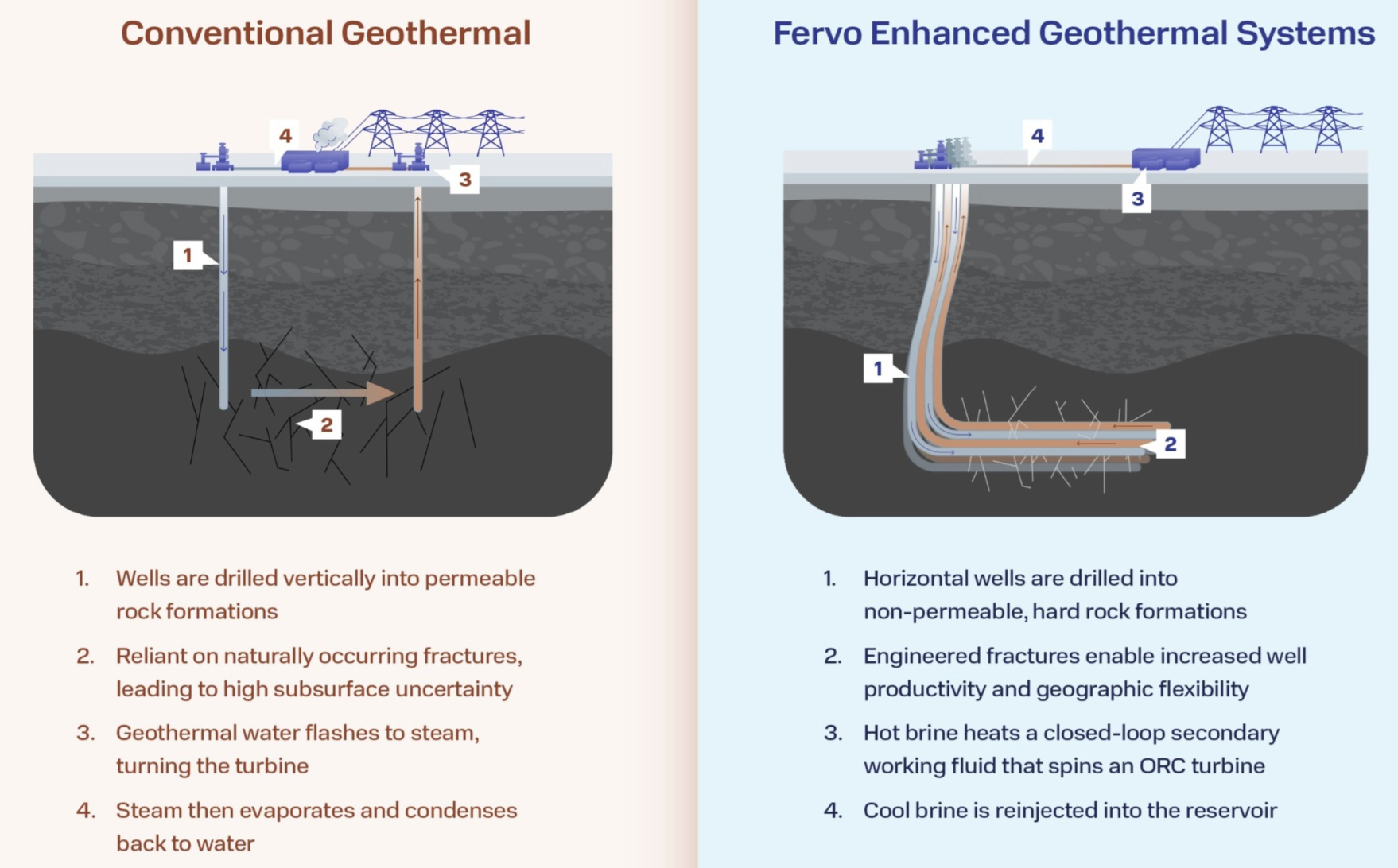
EGS is a “next generation” approach to geothermal that involves drilling thousands of feet into the earth’s crust to find a heat source, fracturing rock formations to create pathways, and then circulating water through these pathways to capture heat. The superheated water is then returned to the surface where it is harnessed to produce electricity. In theory, EGS drastically expands the potential of geothermal energy production.
Considered the holy grail of geothermal, EGS has been technically feasible since at least the 1970s, but commercial viability has proven elusive due to a slew of technical hurdles, including three key challenges:
- Thermal Decline: As water flows through the fractures, the heated rocks cool faster than expected, resulting in declining production temperatures and underperformance that can crush project economics.
- Water Loss: The water that is pumped into the system is not all recaptured, with some “leaking off” to subsurface fractures or faults, resulting in significantly higher operational costs and power production limitations due to limited access to or high costs “make-up” water. [Pgs. 4, 6]
- Induced Seismicity: The fracking process causes seismic events that damage equipment, open unintended pathways that accelerate water loss, or even lead to full blown earthquakes.
As of 2024, there were no commercial-scale EGS systems in operation, according to a paper from Rice University.
Enter Fervo Energy: A Startup Founded By Stanford Graduates With Backing From Bill Gates And Google That Claims It Has Finally Cracked The Code On EGS
Founded in 2017, Fervo Energy is a $4 billion energy company that claims to have overcome the technical barriers and cost constraints that have held EGS back for decades.
Despite having limited professional geothermal experience prior to Fervo, its founders claim that they have overcome the persistent technical roadblocks by applying lessons from the shale revolution to geothermal, as well as through the use of “AI-enhanced” monitoring technologies.[1]
Tim Latimer’s LinkedIn profile shows that prior to founding Fervo, his only relevant experience in the geothermal power generation industry was a 2-month stint at Geo-Energie Suisse AG as a “visiting researcher” and a 3-month internship at ResFrac, a fracking and reservoir simulation company that Fervo utilizes. He also has professional experience in the drilling industry with 3 years at BHP Billiton as a Drilling and Completion Engineer. Jack Norbert’s LinkedIn profile shows that prior to founding Fervo, his only relevant experience in the geothermal power generation industry was a 5-month stint at Calpine, where he acted as a Geothermal Reservoir Engineer and a 4-month stint at Idaho National Laboratory, where he acted as a Computational Geophysicist. He then began an academic career obtaining a PhD in Energy Resources Engineering and a postdoctoral fellowship at the U.S. Geological Survey. ↩︎
Backed by high-profile investors like Bill Gates and Google, last week Fervo announced first power at its first commercial plant, Cape Station, which is expected to commence operations by October 1, 2026, and will scale to 500MW by mid-2028. Fervo raised $2.2 billion in its May IPO to fund this scale-up in one of the largest “clean energy” IPOs in history.
Bull Case: With A “Proven At Scale” Approach, Fervo Has Overcome Historical EGS Challenges And Is Uniquely Positioned To Capitalize On The Power Demand Surge Driven By The AI Boom
The Company Already Has A 1,000 MW+ Backlog With The Likes Of Google And Southern California Edison And Has Land To Develop Up To 50 GW With The Prospect Of Becoming America’s Next Great Energy Company
With the AI boom driving power demand to an all-time high, the U.S. energy grid simply cannot bring on power fast enough, driving a resurgence of interest in geothermal energy and EGS in particular.
Investors believe Fervo is perfectly positioned to meet this demand, with an approach that is “proven at scale” based on ~2 years of testing at its Nevada pilot plant.
By the time it went public, Fervo had already secured 658MW of PPAs worth ~$7.2 billion. It recently signed a second PPA with Google for an additional 396MW – a relationship that has room for expansion through a 3GW framework agreement.
Beyond these initial commercial agreements, Fervo has aggressively acquired land leases for 650,000 acres, representing more than 50GW of potential future capacity expansion in the United States. CEO Latimer believes Fervo’s technology could eventually be deployed across the globe.
While Fervo says that it has been “cost-competitive” since at least 2024, the company claims it continues to slash drilling costs while accessing deeper, hotter formations that improve its economics.
“Demand for around-the-clock clean energy has never been higher, and next-generation geothermal is uniquely positioned to meet this demand … Our technology is fully derisked, our pricing is already competitive, and our resource pipeline is vast.” — Tim Latimer, Fervo CEO
Fundamentals: Fervo Is Valued At 8x 2029 Sales, A 179% Premium To Established Geothermal Peers, Which Assumes Beyond Perfect Execution
Fervo’s shares have declined by 50% from its IPO price, but it remains the most richly valued geothermal operator on the planet – trading at a 179% premium to established peers based on forward revenue estimates. Fervo has never generated revenue from commercial-scale power sales, and thus, in our view, its valuation assumes beyond-perfect execution.
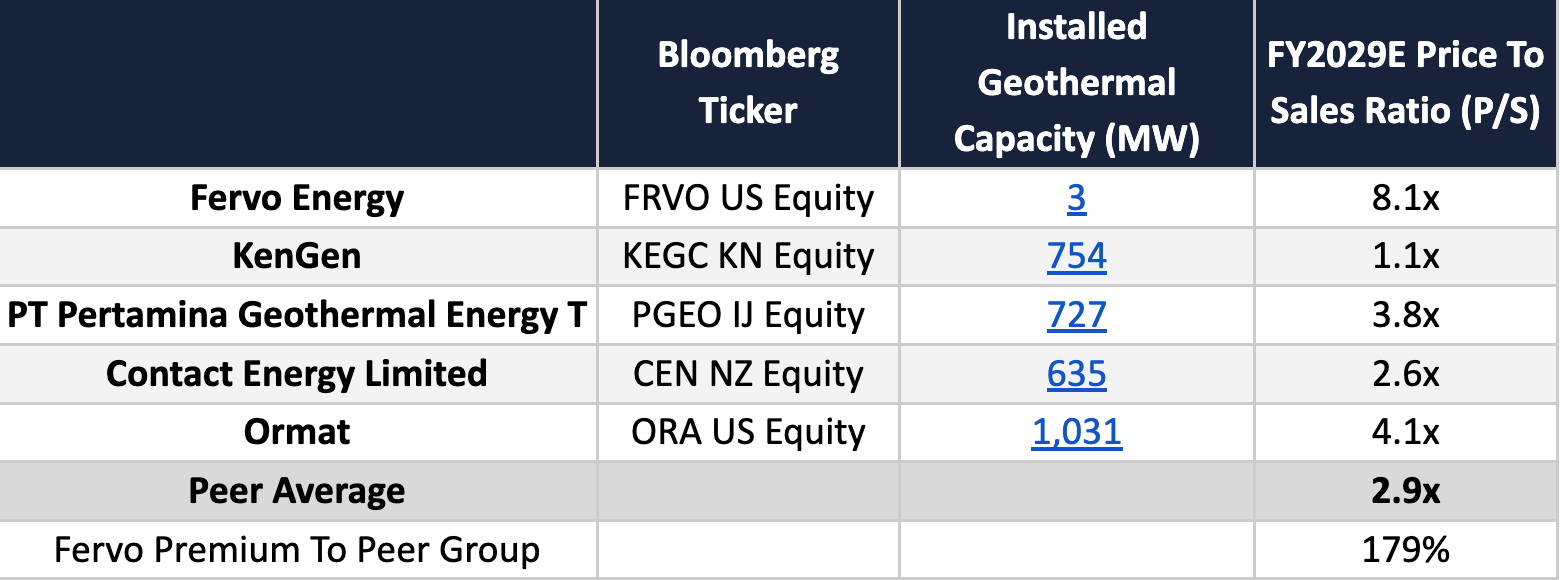
This premium valuation comes even after some geothermal experts have questioned whether Fervo’s approach to EGS is truly “proven at scale.”
For example, over the last 2 years, industry veteran Elliot Yearsley has published a series of critical articles about Fervo, highlighting the company’s “secrecy” and lack of published data. In June 2026, skepticism was further amplified by Enverus, a leading energy analytics and intelligence platform whose in-depth analyses challenge many of Fervo’s core assumptions.
CEO Latimer has characterized skeptics as “keyboard warriors” who seemingly do not know what they are talking about, while touting Fervo’s approach as fully derisked, cost-competitive, and proven at scale.
Adding further pressure to Fervo’s stock price, in early November, a post-IPO lock-up agreement will expire, increasing the number of shares available for sale by almost ~3x.[1]
Fervo filed a prospectus to offer 70 million shares, plus an over-allotment. 205 million shares will become available after the lock-up expiration. ↩︎
Part 1: How Fervo Cherry-Picked And Altered Data From A Failed Pilot Plant To Complete A $2.2 Billion IPO
The market’s enthusiasm for Fervo is based largely on data from its Nevada pilot plant, Project Red. The project was initially pitched in 2023 as a commercial-scale plant that would provide heated brine to the local Blue Mountain power plant, which would ultimately provide power to Google.
We believe Fervo has presented highly misleading data to investors to fool the market into believing its pilot plant was a success and that its approach to EGS is “proven at scale” – a claim that enabled its ~$2.2 billion IPO.
In September 2024, Fervo Co-Founders Published A Paper Showing Consistent Production Temperatures Over 10+ Months Of Operations, Ostensibly Conquering A Major Challenge With EGS Technology
The Supposed Achievement Was Met With Applause And Cheers When It Was Presented To The Public During Fervo’s 2024 Technology Day
Reality Check: The Data Published In The Paper Is Contradicted By Data We Obtained From The State Of Nevada That Reveals Substantial Fluctuations In Production Temperatures
As mentioned, one of the key risks to EGS projects is premature thermal decline – where the subsurface rocks cool down faster than expected, effectively depleting stored heat faster than expected and potentially crushing project economics after CapEx is already deployed.
In September 2024, after 10 months of operating the pilot plant, Fervo claimed during its 2024 Technology Day presentation that the pilot had not experienced any thermal decline. The claim was based on a non-peer reviewed paper authored by Fervo co-founders, Tim Latimer and Jack Norbert, specifically from a chart showing an almost horizontal line with temperatures within the range of 340°F and 350°F. [45:00] [Fig. 3]
When Fervo CFO, David Ulrey, unveiled these results he was met by applause and cheers from the audience. He then said:
“This is a huge moment. We do a lot of diligence meetings, we had a lot of rounds of investments and this was the singular question that people couldn’t wrap their head around: ‘how can I trust that this asset is going to operate how we say it is going to operate?’ And now we have the horizontal line that proves it. That thing is there, is operating like we said it would, 10+ months of operating history, 10+ months of electrons on the grid, it's working, it's real.” [45:30]
CEO Latimer published the same chart from the presentation on his X account, highlighting that Fervo had seemingly conquered one of the “key risks” of EGS.
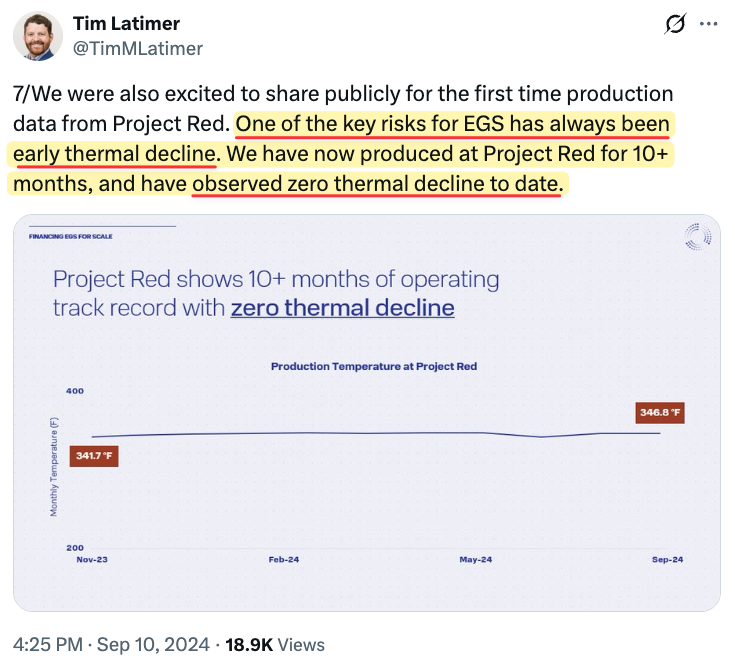
Alongside these results, Tim Latimer announced Fervo’s first-ever construction loan for an amount of $100 million.
As we see it, however, the data Fervo presented appears to be highly misleading.
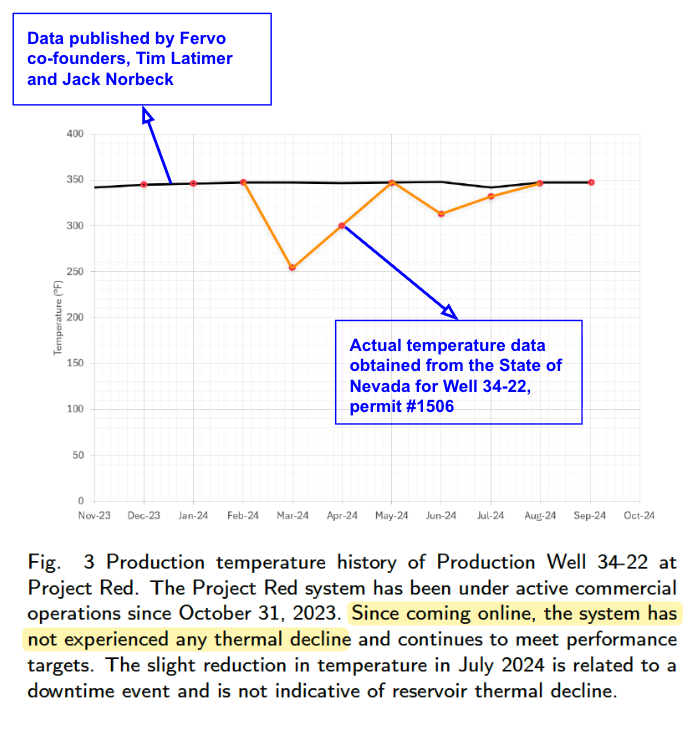
Using the same chart from Fervo co-founders’ paper, we overlaid the average monthly production temperature data for the same well that we obtained from the Nevada Division of Minerals (“NDOM”). This revealed significant thermal fluctuations that Fervo and its co-founders omitted.[1]
Fervo’s pilot plant, Project Red, is located in the Blue Mountain geothermal field, consisting of injection well 34A-22, production well 34-22 and monitoring well 73-22, per Fervo co-founders. (Pg. 2)
Through written communications, NDOM stated that Project Red referred to the well pair that included the (i) production well BM 34(14-23)-22, with permit #1506, and the API #27-013-90147, and (ii) injection well 34A(14-23)-22, with API #27-013-90146 and permit #1505. The well with permit #1506 and API #27-013-90147 was licensed to NGP Blue Mountain I, LLC. This entity is Fervo’s partner in Project Red and operator of the Blue Mountain geothermal plant, where Project Red is located. NDOM publishes a Geothermal Production Data data set containing plant operator-reported data, including monthly average temperature for production wells under the column “TempF.” As of this writing, this data is available from December 31, 2023 to July 2026, for the well with permit #1506 and API #27-013-90147, as defined in the NDOM spreadsheet. We corroborated that Project Red consisted of those wells by identifying the wells showed by Fervo in one of its papers (Fig. 1) and locating the wells at the south west corner of Blue Mountain power plant, south-west of well 61-22 and west of well 34-23, in NDOM’s geothermal production map. To verify this, use the first map on the NDOM website, click “Blue Mountain” on the side bar and locate the wells. This “Geothermal MWh Production” map shows that the the well overlapped with Fig. 1 corresponds to Permit #1506 and API #27-013-90147.
The chart on the Latimer paper has a grid matrix that provides a y-axis scale of 10°F. This allowed us to approximate the position of each of NDOM’s data points. ↩︎
We Believe Fervo Altered The Historical Production Temperature Data In What May Have Been An Attempt To Hide Undisclosed Efforts To Boost Flailing Production In March 2024, When It Injected More Water At The Pilot Plant
The Result: Production Temperature Plummeted And Only Recovered When Injection Volumes Were Brought Back Down, According To Data From The State Of Nevada
Based on the NDOM data, we believe Fervo presented the cherry-picked metric of production temperature and then altered that singular metric to hide the devastating results of an apparent stress test.
Fervo has never discussed this test or its implications with investors, but we believe it explains both the substantial temperature fluctuations that Fervo seems to have hidden from investors, and reveals another operational challenge that Fervo withheld.
Background: EGS involves flowing water through fractured formations of heated rock, where it can heat up before returning to the surface to be harnessed for power. Flow the water too fast, and it might not get hot enough to generate sufficient power. Flow it too slowly, and there might not be enough volume to generate sufficient power. A former Fervo employee explained this:
“If you want higher temperature early on, you’ve got to drop your flow rate so you give the fluid enough time to pass through the reservoir and heat up. And if you’re trying to push fluid too hard to get to a higher flow rate, your heating rate is going to be slow.”
In addition to impacting production temperatures, increased flow rates can also cause an increase in water loss rates - another death knell for EGS projects, historically. If not all of the water that is pumped down comes back up, not only do operating costs skyrocket, but operators must source sufficient “make-up” water or else risk falling short of nameplate power production capacity. [Pgs. 1, 6]
The data from NDOM, which also includes water injection and production volumes, reveals that Fervo boosted flow rates in March 2024, correlating with an immediate drop in production temperature and spiking water losses. Fervo injected ~33% more water into its pilot system than the preceding month, but rather than boosting output, reported production temperatures plummeted by 90°F month-over-month and water loss spiked from 21% to 57%.
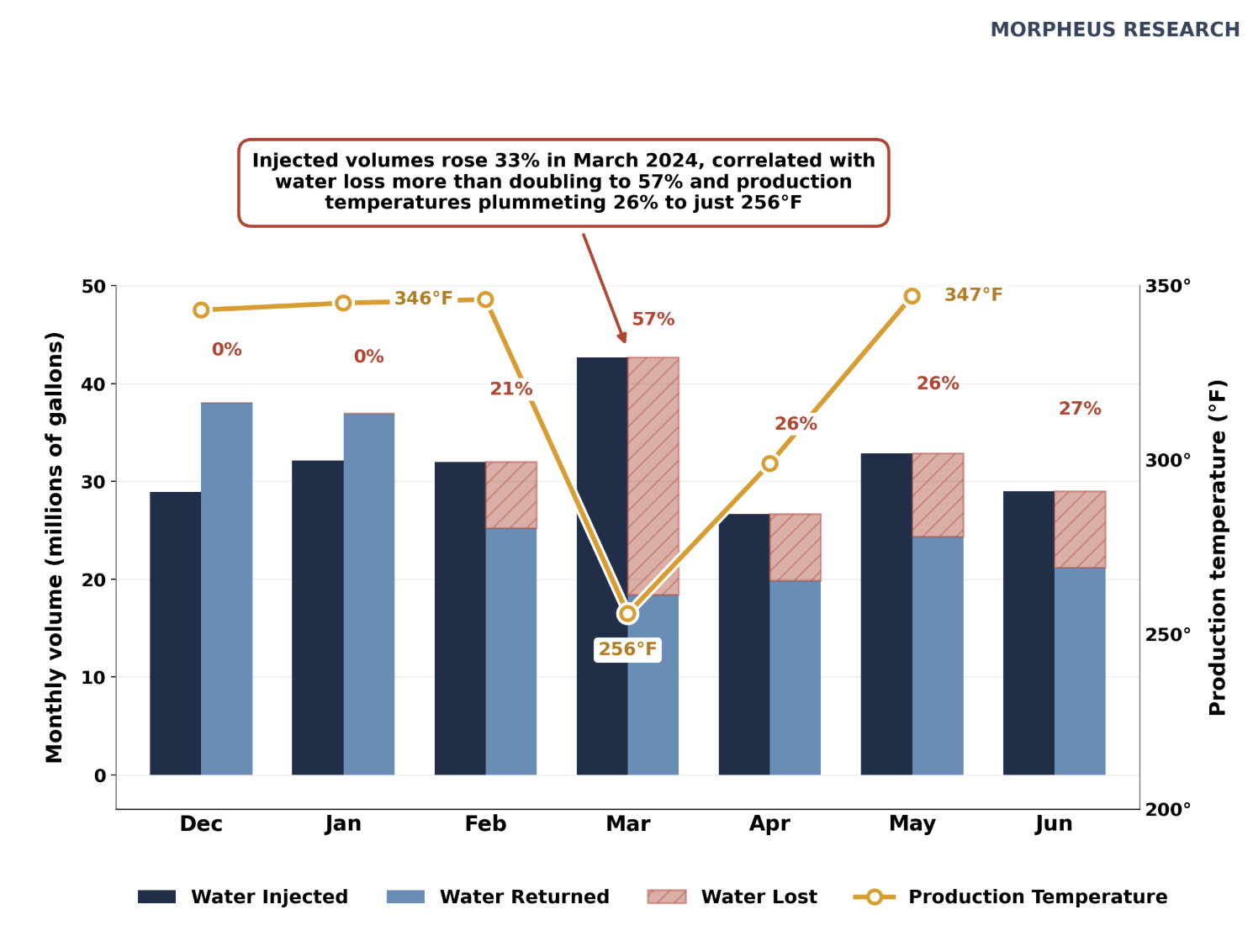
In a December 2024 interview, CEO Latimer stated during an interview with Bloomberg that the Project Red pilot plant achieved “all of the technical objectives of the project” and that the company saw “no evidence of production decline in that year.” Based on the foregoing, we believe these statements were false.
Two days after this interview, Fervo announced a $255 million fundraise.
Fast Forward To 2026: Fervo Disclosed A “Slight Temperature Decrease” In The Final Months Of Testing At Project Red, But Claimed In Its SEC Filings That Project Red “Has Not Experienced The Kind Of Premature Thermal Decline That Has Long Plagued Traditional Geothermal Projects”
Reality Check: Thermal Decline At Project Red Has Accelerated To ~24°F Per Year, According To Data From The State Of Nevada— This Rate Is Nearly 16x What Experts Told Us Was Economically-Viable For EGS
While Fervo’s pilot plant was unable to achieve target flow rates without crushing production temperatures, it also exhibited signs of long-term thermal decline in the final months of testing, indicating an earlier-than-expected depletion of the underlying heat reserve.
Fervo characterized this decline as a “slight temperature decrease,” but one skeptic extrapolated an implied rate of approximately ~9°F per year, which he described as “concerning” and significantly higher than the geothermal industry average, which tends to average about 1.5°F year in his view.

A former Fervo employee suggested that 1°F to 1.25°F per year in declining production temperatures is considered normal for traditional geothermal.
“Traditionally, in the hydrothermal world anything around 1°F to 1.25°F Fahrenheit per year is considered to be okay. And, when it comes to EGS, the idea is you want to drop that temperature decline even further because everything in EGS is based on conduction.”
Fervo retroactively claimed that Project Red’s rapid thermal decline was “predicted” by its models and maintained that the pilot plant confirmed its “theoretical framework” for “EGS longevity.” A former employee disagreed that the decline was predicted, saying that people were “spooked” by the rapid rate of decline.
“No, the actual thermal decline expected was … close to a degree in a year, and a degree in a year is considered fast … So, I wouldn’t agree that it was predicted.”
“The EGS wells are dropping down much faster … people are spooked, like why is this dropping so fast? … the trends are no different [at Cape Station].”
Through our public records request to NDOM, we discovered that thermal decline at Project Red has now accelerated to an even faster rate of 24°F per year. Further, in June, production temperatures inexplicably plummeted by 90°F in a single month.[1]
In the 6-month period from November 2025 to May 2026, we observed a decline of 12°F in the reported temperature, followed by a sharp drop in June followed by a continued downward trend in July. We excluded these 2 months from our estimate, which results in a more favorable rate for Fervo. As mentioned in footnote 3, NDOM publishes Geothermal Production Data on its website which includes average temp (F) of a well. As of this writing, the data for Project Red is available up until March 2026. For the months of April, May June, and July 2026, we obtained monthly reports of the operations of the geothermal field where Project Red’s wells are located, filed by the operator of the plant and reporting average temp (F), for production wells including the well with license #1506. (1, 2, 3, 4) As explained in footnote 3, our communications with NDOM corroborated that Project Red’s production well had permit number 1506. ↩︎
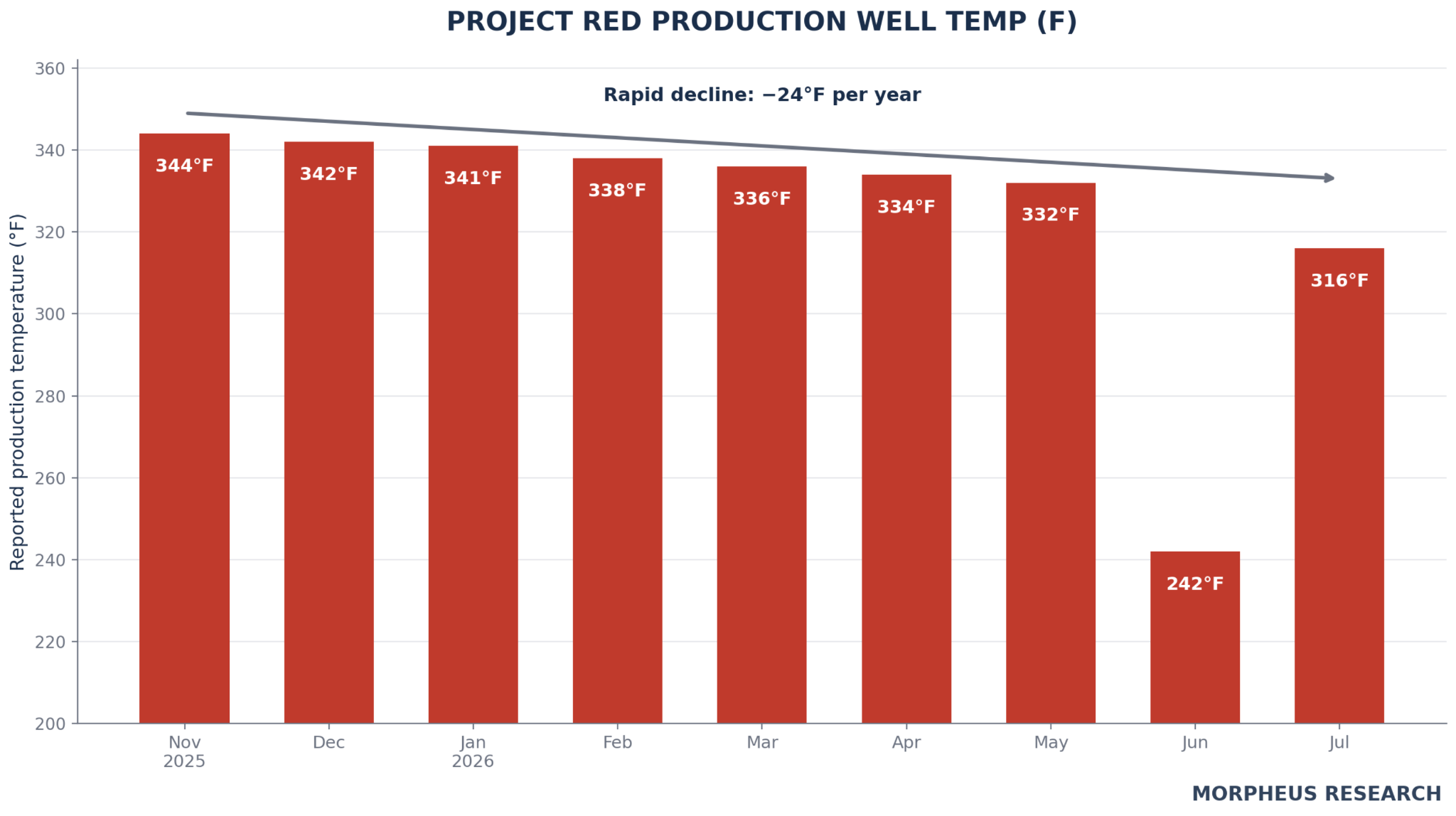
Despite having much of this data in hand, Fervo claimed in its IPO registration statement that its pilot plant did not exhibit premature thermal decline. For the foregoing reasons, we believe this statement was false.
Fervo Claimed Its Pilot Plant Was “Phenomenal From A Technical Demonstration Standpoint” And Used Its Performance As The Basis For Claiming Its Technology Is “Proven At Scale” And Its ~$2.2 Billion IPO
Reality Check: Fervo’s Pilot Plant Missed Virtually Every Stated Performance Target And Generated Just ~41% Of Its Forecasted Capacity, According To Fervo’s Own Predictions And Later-Published Results
In 2023, Fervo published a paper discussing flow rate and power production targets for their pilot plant. [Pg. 15]

After a year, CEO Latimer touted the success of this pilot plant. He called it “phenomenal from a technical demonstration standpoint” and said that it had achieved “all the technical objectives.”[1]
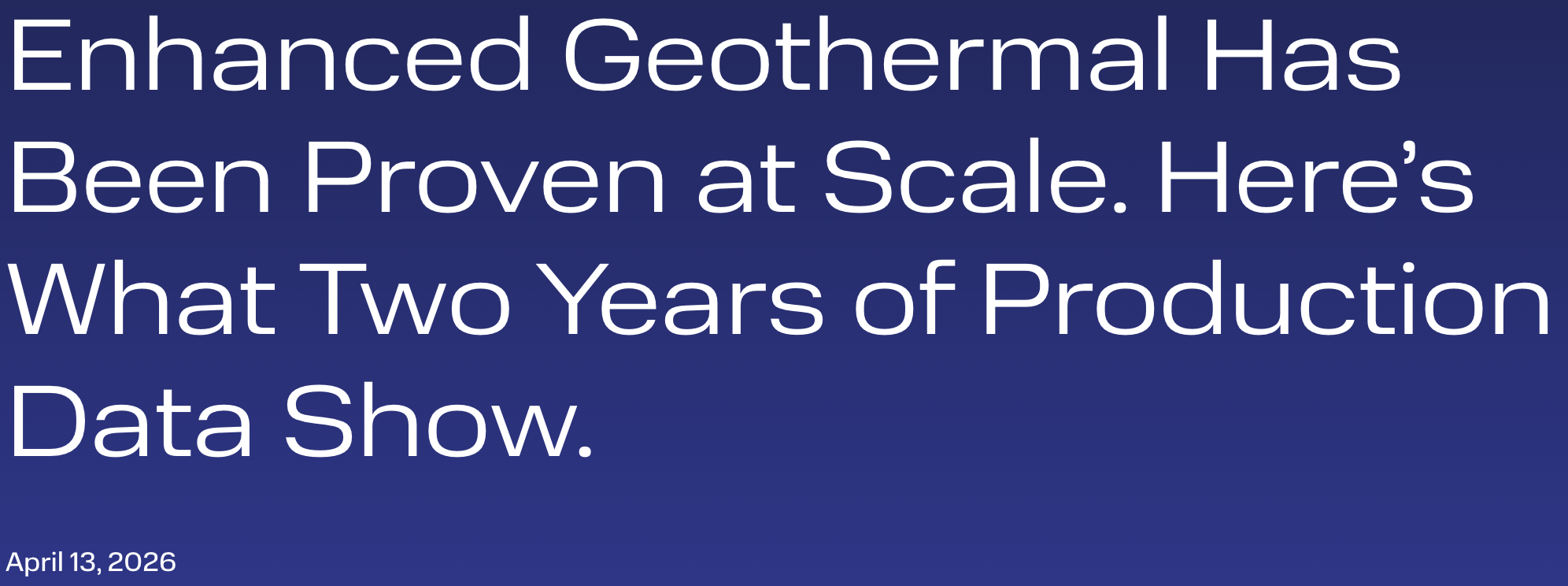
In April 2026, after nearly 2 years of testing, and a month before raising $2.2 billion on its IPO, the company echoed its CEO and claimed that the pilot plant proved its EGS approach. Fervo shared technical results of Project Red in the previously mentioned blog post titled: “Enhanced Geothermal Has Been Proven At Scale.”
Despite the rosy-sounding headline, the post revealed that Fervo sharply missed the performance targets set out in its 2023 paper.
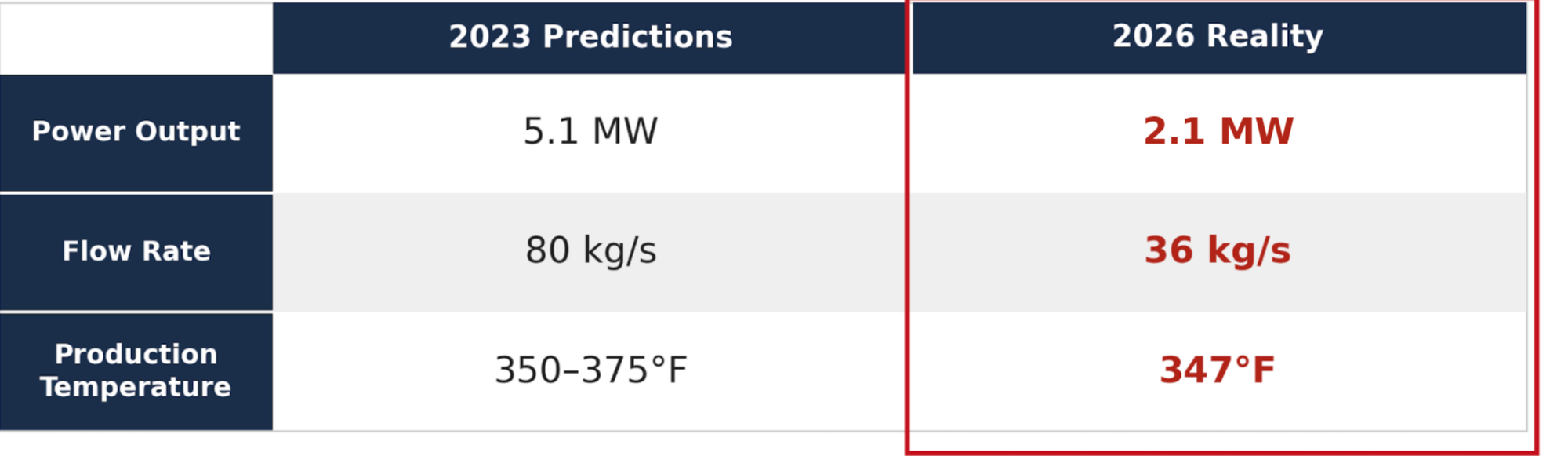
Notably, even though Fervo circulated water at less than half of its projected rate, its production temperatures still fell short of its projections.
Like Past EGS Failures, The Pilot Plant Also Exhibited An Uneconomical Water Loss Rate Of ~30%, Which Is More Than 30x Higher Than The Sub-1% Loss Rate Required For Its Commercial-Scale Ambitions
Fervo Said This Loss Was “Temporary” As The Reservoir “Pressurized,” But Former Employees Were Skeptical Of The “Pressurization” Argument, With One Saying: “It’s A Hypothesis … Fervo Has Not Shown Or Provided Any Public Information To Prove That Point”
Fervo claims that its “modern geothermal” systems have “extremely low water use requirements.” Its commercial ambitions, discussed in more detail further in this report, require that it recapture more than 99% of the water it injects into its EGS systems, reducing water losses to less than 1%.[1]
Energy analytics firm, Enverus, estimates that Fervo needs to achieve a sub-1% water loss rate to “remain within available supply.” Fervo estimates it will achieve a “recapture rate” (the inverse of water loss rate) of 99%. CEO Latimer has also confirmed a 99% recapture (1% water loss) target publicly. ↩︎
Early flow tests at the pilot plant resulted in a far higher water loss rate of between 10% - 20%, per a Vox Media article in which CEO Latimer spun the water loss as a “positive result,” claiming it would “only decline from there.” He was wrong.
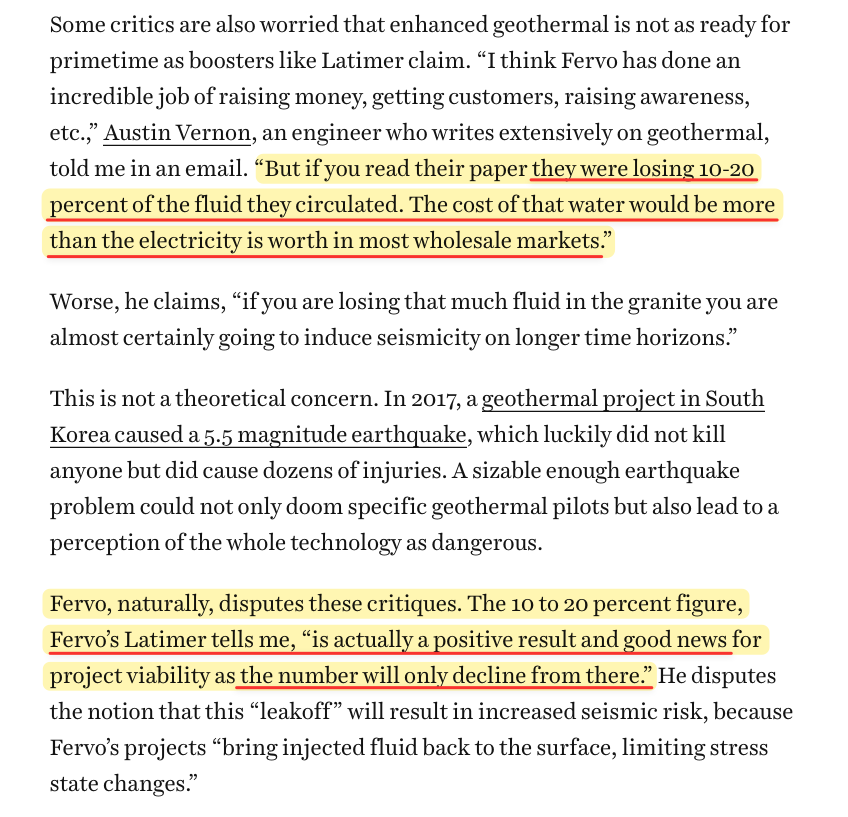
Water loss did not decline as Latimer predicted, but rather doubled and remained elevated over 2 years of testing, according to results published by Fervo.
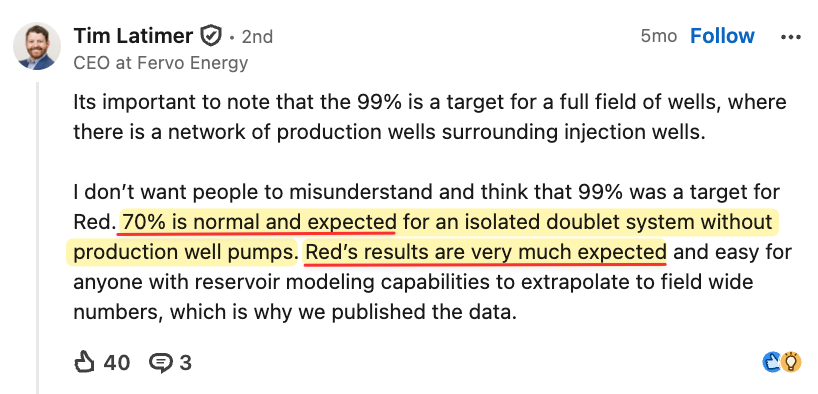
The company again framed the elevated water loss as “consistent with expectations” and CEO Latimer said that it was “normal and expected” despite his publicly-documented prediction that water loss would go in the other direction.
Moreover, the company framed this material water loss as “temporary,” claiming that it should instead be viewed as “reservoir pressurization and saturation rather than permanent water loss.” In a July research note, Jefferies analysts parroted this argument – apparently taking management’s word for it.[1]
Jefferies research note, July 20, 2026. ↩︎
“Results from Project Red state that injected water that does not immediately return to the surface is not permanently lost, but is instead temporarily stored within the underground reservoir. FRVO reported an initial recapture rate of roughly 70% under steady-state conditions, leading third-party reports to incorrectly cite 30% water loss.” — Jefferies, July 20, 2026
We asked a former Fervo employee about the pressurization theory, and they referred to it as a “hypothesis” for which Fervo has provided no data.
Former Fervo Employee: “And that’s where there is very little data out there. And, it’s a hypothesis that, at this time, Fervo has not shown or provided any public information to prove that point.”
Data We Obtained From Nevada Reveals That Water Loss Is Not Improving At Project Red As Fervo Predicted, Reaching 35% In June 2026 And Revealing That Fervo’s “Pressurization” Theory Has Not Yet Worked In The Real World
Fervo claimed in April that water loss is a “temporary” problem, but we obtained records directly from the Nevada Division of Minerals (“NDOM”) revealing that the pilot plant’s losses were consistently high from November 2025 through July 2026 and are not declining as expected. For example, in June, water loss hit a 10-month high of 35%, despite lower overall injection rates.[1]
Through our public records request we obtained the reports showing the data for April, May, June, and July. (1, 2, 3, 4) The data obtained from NDOM also includes the amount of gallons injected for the injection well (1505) and gallons produced for the production well (1506), see footnote 3 for more details. ↩︎
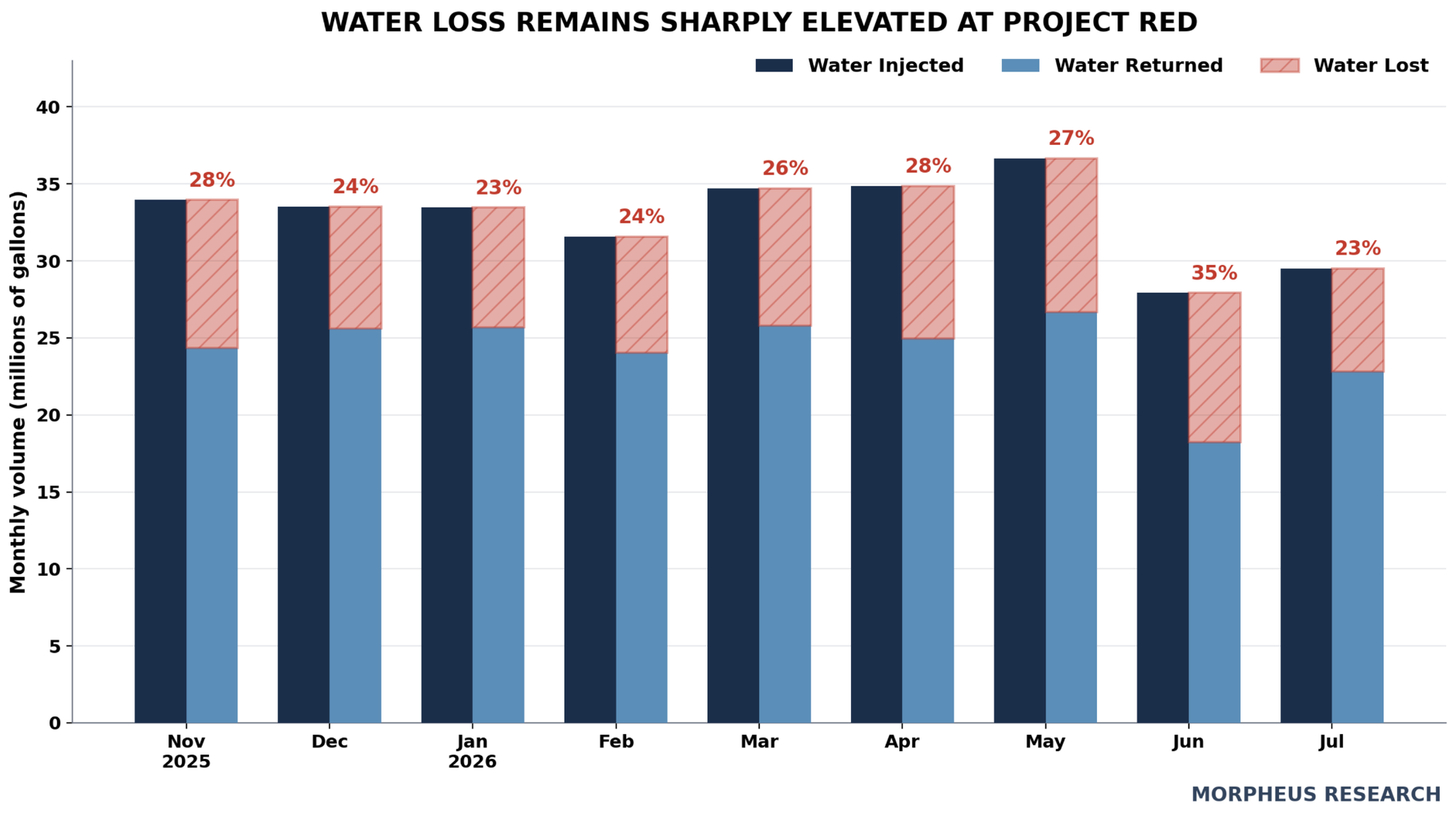
Since December 2023, Project Red lost 193 million gallons of water to subsurface leak-off, per data obtained from NDOM.
Part 2: Fervo Is Withholding Key Operational Data From Its First Commercial Site, Cape Station, While Downplaying Existential Water Loss Risks
Fervo’s pilot plant drastically underperformed expectations while exhibiting deeply uneconomical rates of premature thermal decline and water loss – indicating that Fervo has yet to provide any evidence that it has conquered the same key challenges that have inhibited EGS historically.
Despite this, Fervo doubled down by claiming its approach is “proven at scale” and raising ~$2.2 billion through its May IPO to build a much larger commercial-scale EGS site in Utah, known as “Cape Station.” Investors believe the structural failures of the pilot plant will somehow disappear at scale.
Fervo Has Indicated That Water Loss Will Improve By Over 30x To Less Than 1% At Its Cape Station Project Due To “New Well Designs” – A Loss Rate That Has No Close Precedent Globally, And For Which Fervo Has Provided Zero Evidence
Industry Experts Were Skeptical Of This Target, With An EGS Veteran Telling Us: “As With Everything, They’re Very Aggressive In Saying, ‘This Is What We Can Get To’ … Without Demonstration Of How They’re Going To Get There”
Former Employees Warned Of Major Water Loss Risks At Cape Station, With One Saying: “When You Frack Granite, You Basically Open Up A Gap And You Are Going To Have Massive Fluid Leak-Offs. That’s The Main Issue That Is Going To Be Seen [At] Cape Station”
Fervo says that its new well designs will be significantly better than the pilot plant and that it expects to lose less than 1% of circulated water at Cape Station. Despite Fervo’s confident posture, there is no commercial precedent for these projections in EGS, and the company has not released operational data to support the claim.
Industry experts, including local stakeholders and former Fervo employees, were skeptical that this is achievable. For example, one former employee explained that, in their view, the rock structure at Cape Station is less favorable for water loss than at the pilot plant and that water losses are going to be “massive.”
“The rocks have much lower water leak-off rate at Project Red because the rock structure is more like shale … so the water [loss] is not as big of a problem, even though we are seeing a 70% [water] retention rate, but the rock structure is really good at [Project] Red.
Project Cape Station is much different because it’s pure granite … when you frack granite, you basically opened up and you are going to have massive fluid leak-offs. That’s the main issue that is going to be seen [at] Cape Station.”
We asked the former employee specifically about Fervo’s claim to reduce water losses to 1% or less.
“They are banking on the idea that they can grab the unwanted fractures with a different well, [but] there is no data behind it, and that’s what worries me."
"… without any data, I just have a very hard time believing that …”
Another person who worked for Fervo was skeptical of the 1% loss rate and Fervo’s modeling capabilities, saying that there is not a “brick wall” around the reservoir that will allow it to pressurize.
“A sub-1% [water loss] permit requirement at Cape Station. I don’t know how they’re going to be able to achieve that, especially long-term. I know ResFrac had done some modeling for them as well … and said that, as the water goes in and, eventually kind of pressurizes the reservoir, the formation, there is going to suddenly become a bit of a boundary condition, to basically kind of put an edge around the jug, so to speak. I don’t necessarily buy that either …
I look at it as almost pouring the ocean on the ground, right? It’s just going to continue to run … as they put more flow into the ground and lose more water to formation, there isn’t a brick, a truly brick wall at some point at the edge of the reservoir that they’re going to run into.”
We interviewed an EGS expert from the University of Utah’s Project Forge, a DOE-funded EGS exploration project that collaborates with Fervo, who characterized Fervo’s water loss targets as “aggressive” and highlighted a lack of demonstrable performance and the potential shortcomings of simulated results.
“As with almost everything, they’re very aggressive in saying, ‘this is what we can get to,’ and ‘this is what we expect,’ without demonstration of how they’re going to get there, necessarily … simulation is simulation. You can make anything possible in simulation. Your geology does not always agree with your approach.”
ResFrac, the company that modeled the sub-1% loss rate for Fervo, is run by Mark McClure, who introduced Fervo co-founders Norbeck and Latimer during their tenure at Stanford. He joined Fervo’s co-founders at the Nasdaq opening bell during the IPO and currently serves on the advisory board.[1]
Mark McClure was a part-time professor at Stanford at the time that Fervo co-founders Latimer and Norbeck were students there, per their LinkedIn profiles. ↩︎
CEO Latimer Has Referred To Skeptics As “Keyboard Warriors” Who Do Not Have Access To The Right Data To Gauge Project Viability, But Fervo Is Inexplicably Withholding Key Data From Cape Station Tests, Including Water Loss
A Former Fervo Employee Told Us Neither Issue Is Solved At Cape Station, “I Can Tell You The Water Loss Rate Was Not What … They Were Hoping. It Was Much Worse Than What They Wanted To See”
During Fervo’s Q2 earnings call, CEO Latimer referred to the company’s critics as “keyboard warriors” who do not have access to the proper data, despite withholding key operating data on Cape Station’s water loss and other key metrics from investors.
In September 2024, Fervo published a press release touting “record-breaking production results” from a Cape Station flow test at its “Frisco” pad. Despite the test running for 30 days, Fervo only released 24 hours of power production data and omitted key operating metrics including water loss. [Pg. 5]
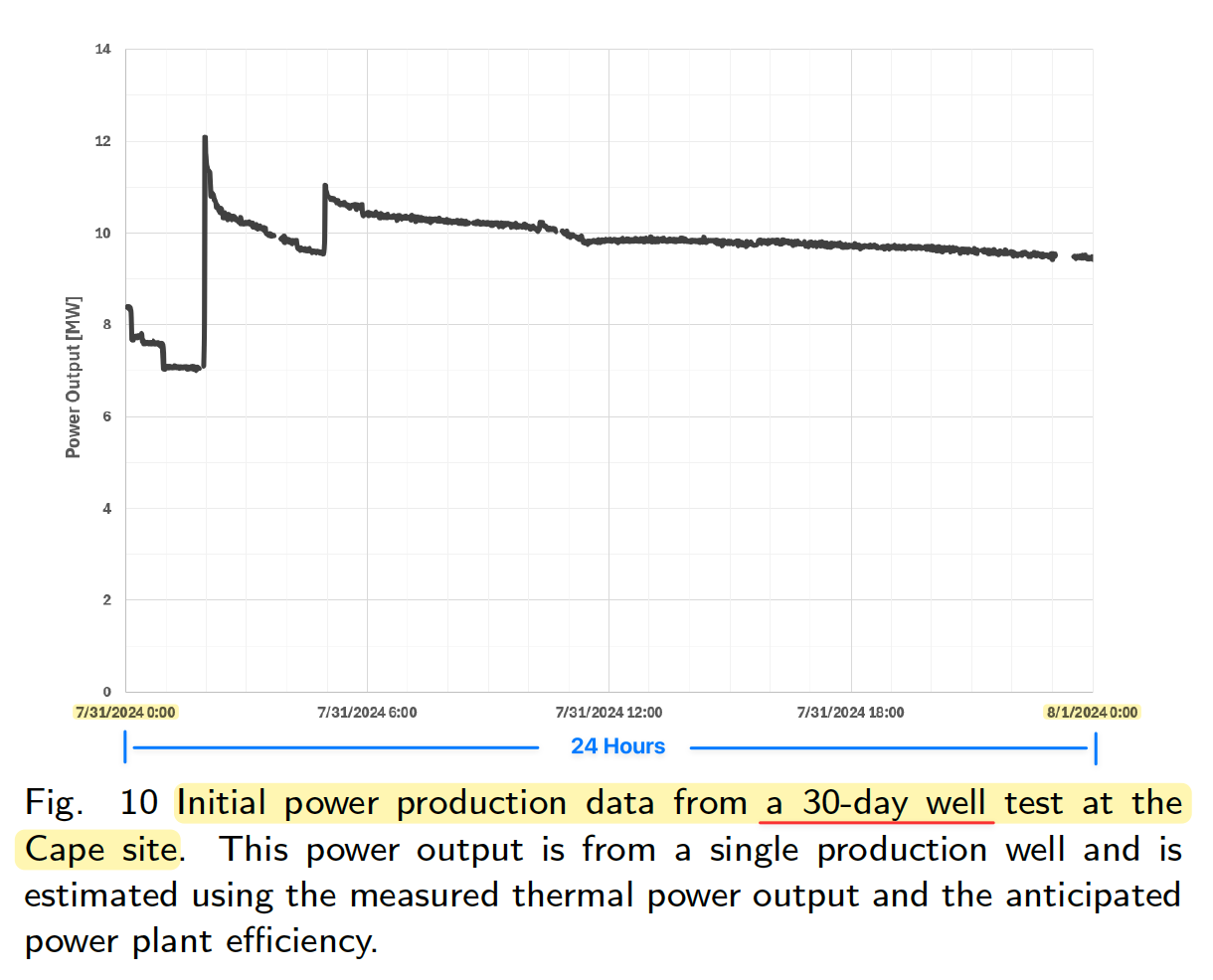
We interviewed an expert from Project FORGE, who highlighted this:
“A lot of details are missing … the pressure, the circulation rate – what’s the water loss? They have done some circulation [testing], but they do not report the water loss of their circulation in Cape [Station] … They did not release their data.”
Elliot Yearsley, a geothermal expert who writes for GEOExPro, also scrutinized the framing of the test results, questioning the sustainability of the flow rate while highlighting indications of water loss.

Even Mark McClure, CEO of Fervo contractor ResFrac and member of Fervo’s technical advisory board, highlighted a lack of data around water loss, suggesting the possibility of “significant net fluid loss.”
We asked former Fervo employees why the company failed to share the full data set from its Cape Station flow test.
“The major reason was the reservoir was not steady. The production could not be held consistent. And so, they were worried that if they show the data, that will put a lot of questions in the market in terms of viability… the results weren’t as good.”
“The idea was that in the software, ResFrac, that’s the software that Fervo uses, the software created very strong conductivity … when the real time results were shown, those were much, much weaker and that basically led Fervo to believe that the fracture is way more complex in the granite than they were initially expecting. That also meant that a lot of fluid that they thought was going to come back to the surface wasn’t coming back.”
The former employee said:
“I can tell you the water loss rate was not what … they were hoping. It was much worse than what they wanted to see.”
A second former employee corroborated the water loss issues, telling us that Fervo’s “pressurization” theory is not working in the real world, so far.
“Right now, they’re relying on the concept of, like a balloon, they inject at a very high pressure to pump up the balloon and then as they poke the producers [wells] into it, that pressure is what lifts the fluid to the surface. And so far, they’re struggling with that because that’s the mechanism that’s creating a lot of water loss… the producers, that they’re poking into the balloon, aren’t returning a lot of water. The water’s staying down in the balloon.”
Fervo’s March 2026 Credit Agreement Mentions A Second Flow Test At The “Bearskin” Pad That Appears To Have Been Completed By October 2025, But Results Were Never Disclosed To Shareholders
A Former Employee Told Us The Results Were Even Worse Than The Initial “Frisco” Test, Saying: “The Bearskin Test Was Even Worse Than The Previous One”
Data from flow tests at Cape Station is the only way for investors to assess the viability of Fervo’s commercial ambitions, but the company has not produced this key data while continuing to state publicly that their technology is fully derisked and cost-competitive.
Fervo appears to have run a second flow test at its “Bearskin” pad at Cape Station, the results of which were internally reported in October 2025, according to a credit agreement. [Pg. 12]
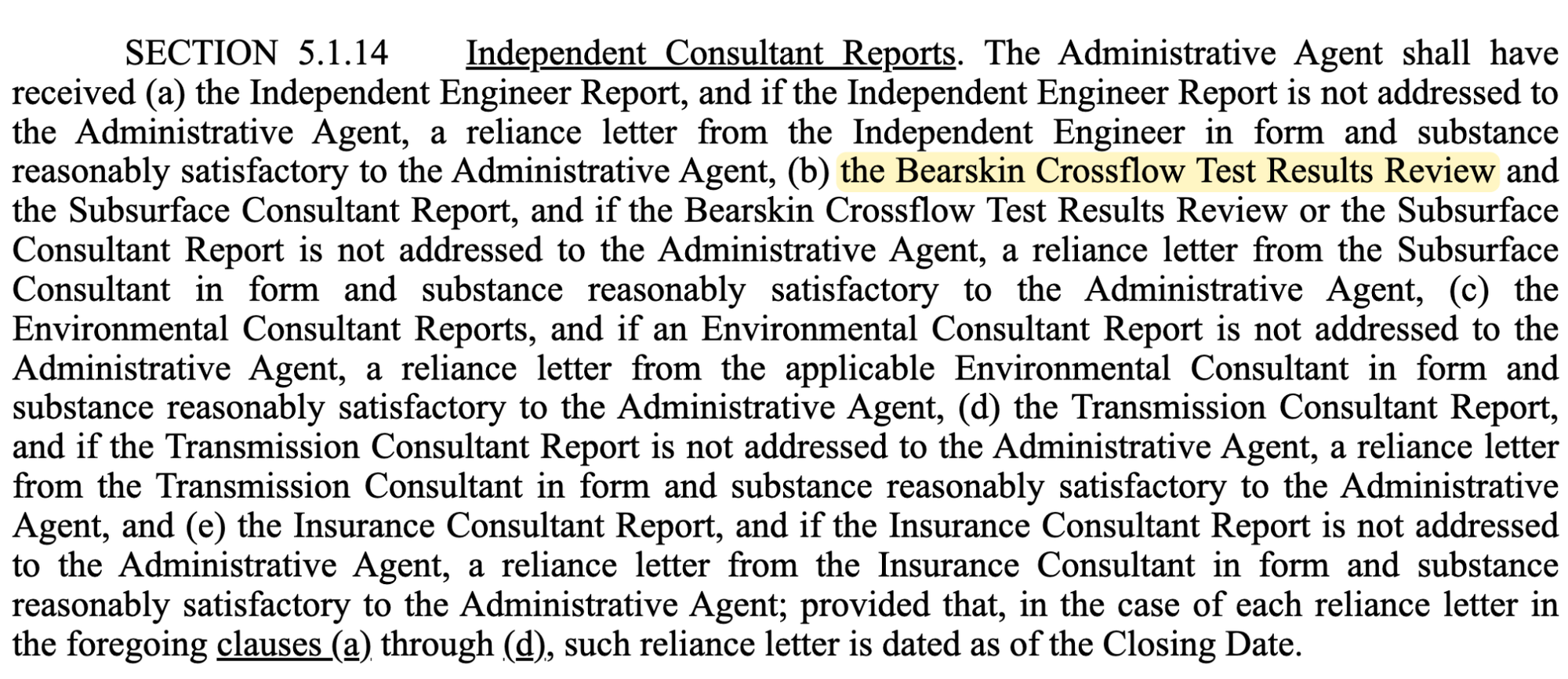
Despite providing this data to creditors, Fervo never clearly disclosed this test to its investors as far as we can tell. On the Q1 earnings call, CEO Latimer vaguely referenced a well test on “key pads” at Cape Station, which supposedly showed that key operating metrics were “all in line with expectations.”
A former employee said the Bearskin test was even worse than the Frisco test mentioned above.
“The Bearskin test was even worse than the first one.”
Another former Fervo employee told us that water issues could “kill their project” and that the company is being “overly optimistic” while “intentionally concealing” problems.
“I think they’re overly optimistic in talking about the good things at Cape [Station], but not mentioning the bad things and intentionally concealing them until they can figure out how they want to talk about it. So, I think that overall erodes my trust in what they’ve, what they’re saying.”
“I think, long-term, they need to be transparent with the water … because the water loss is certainly something that could kill their project. So they certainly need to be honest on that.”
The Drought-Stricken State Of Utah Is Only Allowing Fervo To Access Water Based On A “Non-Consumptive” Designation, Which Relies On Fervo’s Claim That Water Lost To Its EGS System Will “Eventually” Migrate Through Thousands Of Feet Of Granite Back To “Recharge” The Source Aquifer
Industry Experts Disagreed With This Claim, With A Former Employee Saying “That’s Just Not How Mother Nature Works” And A Project FORGE Expert Telling Us “My Opinion Is That Is The Rosiest Picture They Could Present To [Utah Regulators]”
We Believe Most Investors Have Taken Water Access For Granted While Ignoring The Potentially Existential Consequences If Fervo’s Claims Fails To Work In The Real World
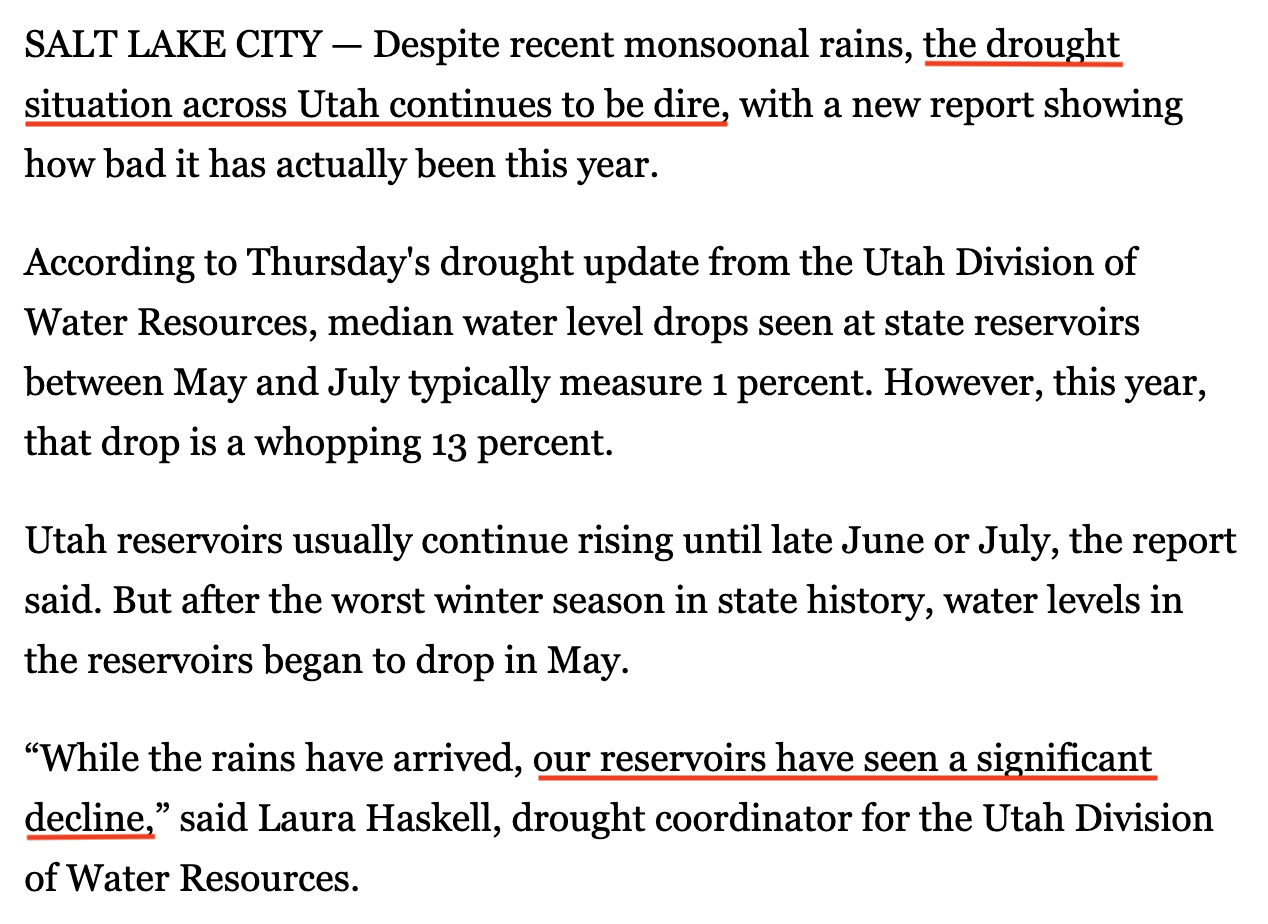
Even at optimistic water loss estimates, Fervo’s Cape Station EGS systems will require substantial amounts of water. Cape Station is located in an area of drought-stricken Utah where state regulators are not granting any new water appropriations, presenting a potential challenge for Fervo.
For this reason, Fervo applied for and obtained a “non-consumptive” appropriation – based on an argument that is both technically nuanced and which has existential ramifications for Fervo’s future. [Pg. 3]
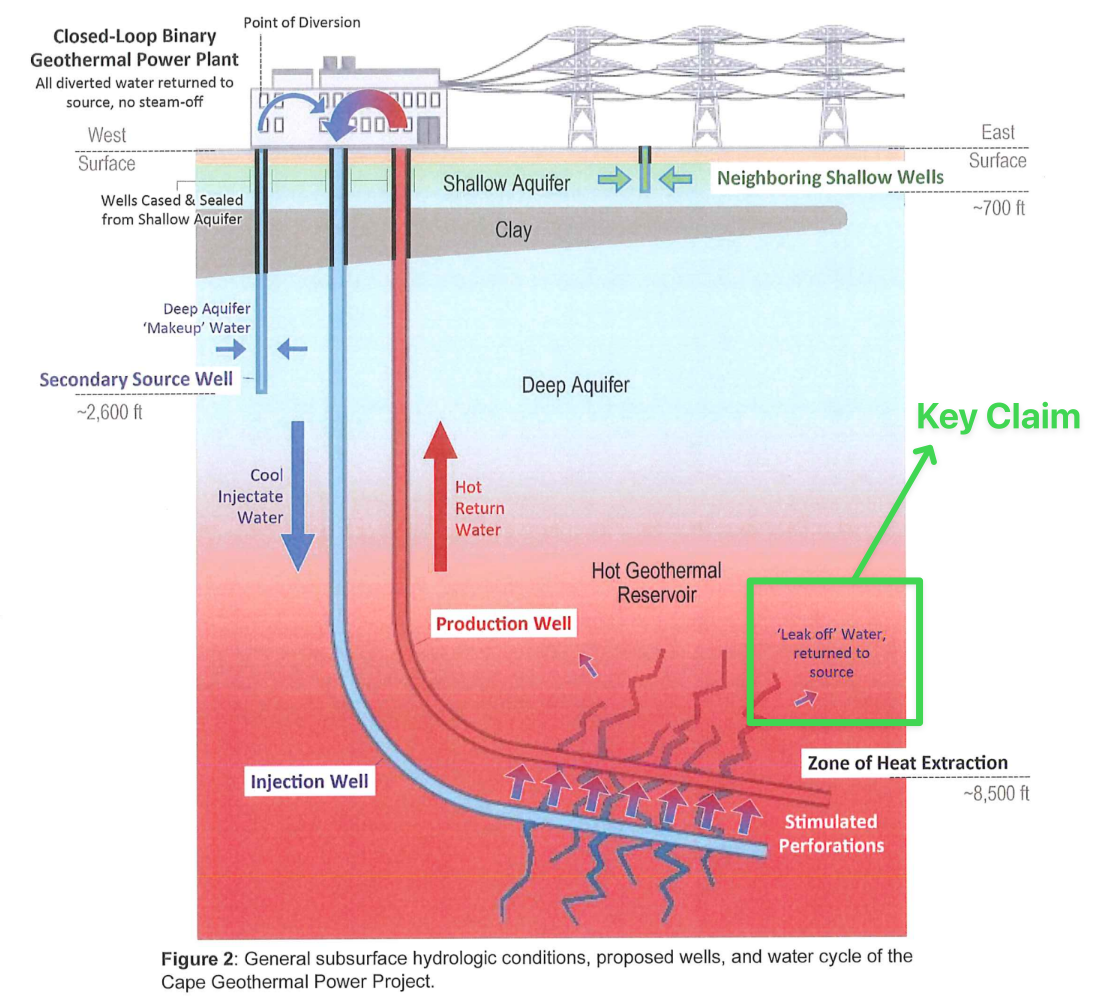
Fervo’s argument is that any water lost to subsurface “leak-off” in its EGS system will simply migrate vertically back to the “deep aquifer,” rendering its use “non-consumptive” even if operational water losses are high, according to its filings with the State of Utah. [Pg. 4]
“The proposed water diversion is non-consumptive; as detailed in previous responses, no water will be removed from the aquifer, and water diverted to deeper layers of the aquifer will not be consumed as the aquifer is hydrologically connected between all depths proposed for diversion and re-injection.”
Fervo included an illustrative image showing that it will pump water from the “deep aquifer” at 2,500 feet, inject it into its EGS system at ~8,500 feet, where any “leak-off” water will somehow migrate back 6,000 ft to the original deep aquifer.
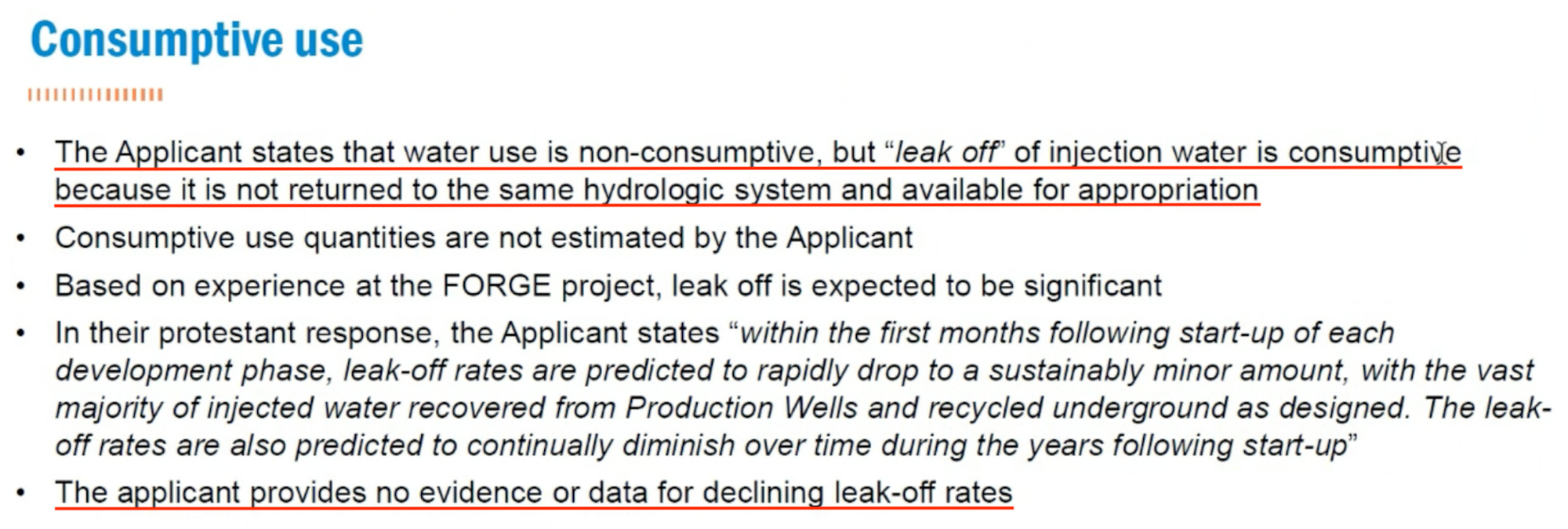
Some local stakeholders are also skeptical of Fervo’s “non-consumptive” claim. For example, local power company PacifiCorp submitted a protest letter to Utah state regulators, arguing that Fervo has provided “no evidence” for declining leak-off rates or the theory that water lost in the system will somehow migrate back to the same “hydrologic system.”
We asked an EGS expert from the nearby Project FORGE about this debate, who summarized Fervo’s argument and then told us it was the “rosiest picture” Fervo could present to regulators and stakeholders.
“... ‘any water losses from the reservoir, from the EGS system itself, will percolate back up and recharge that deep non-potable aquifer’ ...
My opinion is that [this] was the rosiest picture they could present to the Utah Division of Water Rights and all of the people who had protested that huge allocation … ‘we’re going to lose some water to the subsurface, but it’ll just float back up to where we got it and it won’t affect anybody else.’”
The expert referred to the idea that leak-off water will somehow recharge the aquifer thousands of feet above it as a “head scratcher.”
“I would like some real answers on their water loss numbers, specifically as it relates to pulling water from the deep [brackish] aquifer. Like, what they think the recharge rates there will be and why they think that would be the case. That’s been a real head scratcher for me.”
A former Fervo employee also contradicted Fervo’s narrative, telling us:
“The water seeps very slowly … So, I wouldn’t agree that Fervo’s statement saying water discharged at 8,000 feet is recharging at 2,500 feet. That’s just not how mother nature works.”
“I believe Fervo basically has shared in the public realm that they are not losing any water. It’s all getting recharged. And so, in short summary, what you just said is exactly what Fervo has been pushing out in the public ecosystem, but it’s not reality.”
Energy analytics firm Enverus also cited this as a risk to Cape Station’s water access, saying that if the water migration theory fails in the real world, Fervo could face challenges to its water rights.
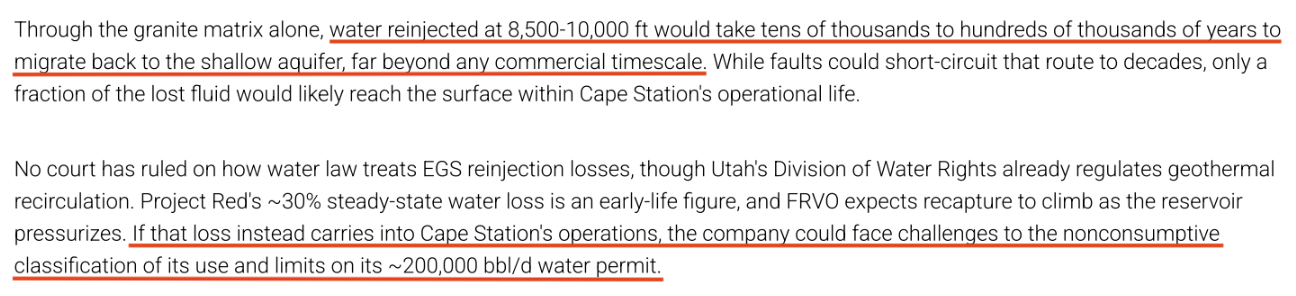
We think investors are taking Fervo’s access to water for granted. It rests on a nuanced hydrological argument, backed by little evidence, and with which numerous industry experts and local stakeholders have disagreed.
We contacted the water rights office of the state of Utah, who told us they would monitor Fervo’s water usage and “evaluate whether additional action is necessary” to protect senior water rights holders. The regulator confirmed that Fervo will be required to submit data on how much water is “diverted, injected, and produced,” which we believe will provide the public with an opportunity to independently assess water losses if Fervo decides to continue withholding this critical data.
In sum, Cape Station faces numerous challenges, and we see little evidence that Fervo has overcome the numerous technical hurdles that have inhibited EGS historically. In our interviews with EGS experts, including many who have worked with or for Fervo directly, we encountered immense skepticism about its claims. This perspective was summarized by an individual formerly employed by Fervo, who told us:
“Everybody I talk to is highly skeptical … the conversations I have with my old colleagues and friends and other technical people are like, ‘how does the investment community keep buying the hype? Like at what point, at what point do they stop ignoring the facts and the technical skepticisms and the challenges here?’
I mean, I'll be honest, I got to hand it to Tim and, and, and the Fervo team, they do a great job of like media blitzes and really hyping, you know, really executing some hype around it. They do a great job of, at a very fundamental level, like, you know, um, I'll say controlling the narrative.”
Part 3: Selling Power Below Its Cost, The Myth Of Capex Reduction And How Fervo’s Current PPAs May Be Setting Up The Company For Failure
As mentioned, since at least 2024, CEO Latimer has claimed that Fervo’s approach is “cost-competitive.” Until Fervo proves that it can sustainably hit net power targets without excessive thermal decline or water loss, these claims have little weight, in our opinion.
Even taking Fervo’s claims at face value, it appears that Fervo will be losing money on every megawatt-hour sold due to pricing its power below cost. Because of this, Fervo is betting on achieving significant cost reductions over time if it is ever to be profitable.
Fervo’s PPAs Appear To Be Priced Below Current Cost, Meaning Fervo Will Lose Money On Every Megawatt-Hour Sold Unless It Can Achieve Significant Cost Reductions
“They Signed Up These PPAs With A Haircut Already In Place, Knowing That There Was A Risk They May Not Deliver” – Former Fervo Employee
Until the recently announced Google PPA, Fervo’s largest customer was Southern California Edison (“SCE”), with 320MW contracted and an initial 70MW of capacity scheduled that was supposed to turn on in January 2027. The average price under this contract is $99/MWh, according to Jefferies.[1]
Southern California Edison’s letter of advice 5207-E describes how it contracted for 70 MW from the Cape Station facility is set to have an initial delivery date of January 1, 2027, the same date disclosed by Fervo as the deadline to commence operations for Cape Station Phase I (Units 2-3). (Pg. 22) Jefferies initiating coverage of Fervo from May 27, 2026. ↩︎
This appears to be less than Fervo’s overall cost to produce energy, even taking its claims at face value. Financial advisory firm Lazard estimates a cost of $107/MWh for “new geothermal,” and the footnotes of its report reveal inputs of $7,000/kWh in CapEx and $160/kW-per year in O&M to estimate that cost. These inputs match the figures disclosed by Fervo.[1]
Lazard utilizes Levelized Cost of Energy (“LCOE”) — a measure of the overall cost to build and run a power plant. We used Lazard’s LCOE for new geothermal as Fervo’s effective cost estimate— not as a GAAP metric. See footnote 5 on Page 7 for Lazard’s assumptions for “new geothermal.” Despite Fervo’s CEO calling LCOE a “flawed metric”, it has been previously used by the company to argue that geothermal is cheaper than other renewable energy sources. ↩︎
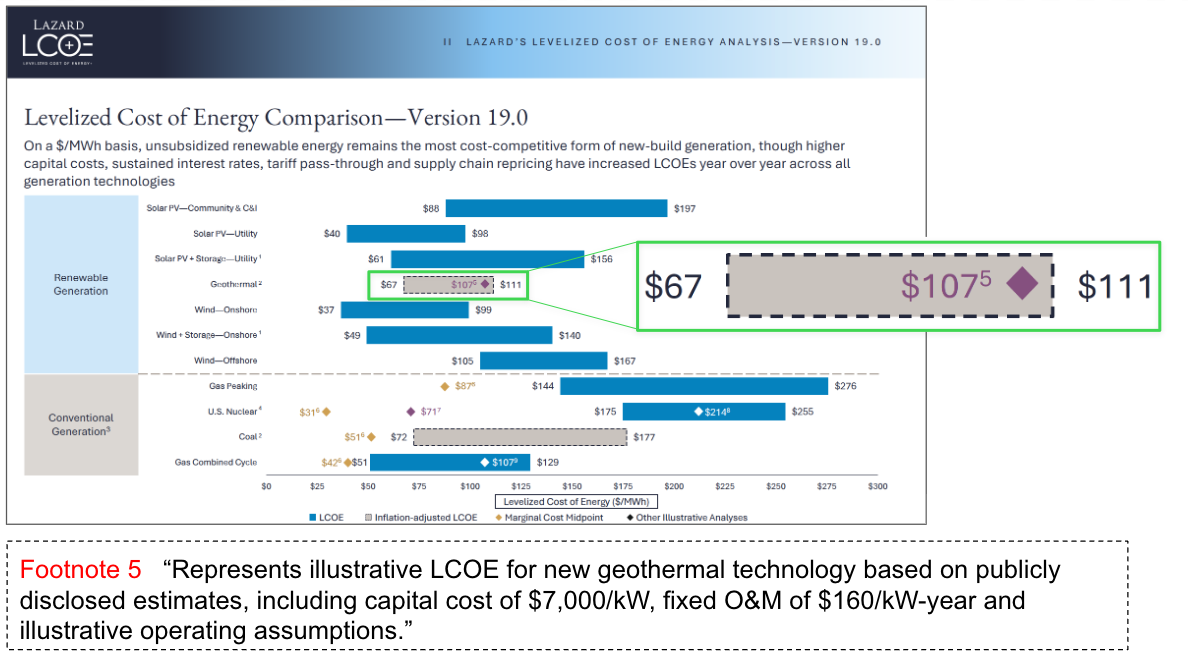
Fervo’s pricing indicates that substantial cost reduction will be needed to achieve profitability. A former Fervo employee highlighted this as a risk across Fervo’s entire backlog.
“They said they’ve got 658MW of PPAs over 15-year terms for an approximate value of $7.2 billion. Well, if you do the math on a mWh basis, that’s only about $83 to $85 a megawatt-hour … So, they signed up these PPAs with a haircut already in place, knowing that there was a risk they may not deliver.”
Fervo Believes It Can Achieve A 57% Reduction In CapEx Per Installed kW, Which Former Employees Describes As A “Huge Challenge” And A “Try To Get The Stock Price Up” Claim
Red Flag: Fervo’s CapEx Per Installed kW Has Been Rising Rather Than Falling, According To Fervo’s Disclosures Over The Last 2 Years
Facing pressure to cut costs, Fervo has focused on a singular metric: CapEx per kilowatt of production capacity. Despite the importance of this metric, a review of Fervo’s historical claims indicates that this number is increasing, not decreasing.
While it estimates current costs of $7,000 per kW, it has communicated that it “continues to expect” costs to drop back down to $5,500 for Phase 2 of Cape Station, with a long-term goal of $3,000, a 57% reduction. A former employee was highly skeptical of this type of cost reduction:
“I know they project they want to get to $5,500, and the language they used in the latest drilling release was like, ‘yeah, we’re on track for $5,500.’ Well, ‘on track’ is kind of creative language for, we’re not there yet but we want to get there … I think that’s a ‘try to get the stock price up’ line.”
Another former employee said that Fervo’s economics are “inflated” and that even the most recently disclosed CapEx figure of $7,000 is a “huge challenge.”
“I would say, yes their numbers are definitely inflated … I am not so sure why they feel very positive that they can get down to $3,000 … to me, $7,000 was a huge challenge.”
“To me, it’s very shocking and surprising that people are willing to admit and agree that what Fervo is publishing is gospel.”
Fervo Touts Drilling Cost Reductions As A Key Driver Of Lower CapEx And Included A “Drilling Cost Per Foot” Chart In Its 2026 S-1 SEC Filing Showing Declining Costs Over Time
Reality Check: This Chart Hides Rising Drilling Costs, According To The Same Chart From 2024
On Its Q1 Earnings Call Fervo Declined To Provide Details On Drilling Costs, And May Be “Very Close To The Plateau” On Drilling Cost Reduction, According To An EGS Expert From Project Forge
As part of the CapEx reduction, Fervo has touted rapid reductions in drilling costs as the primary driver of CapEx reductions, citing a 70% reduction from 2022 to 2025. Most of these gains, however, appear to have been captured 2 years ago.
For example, in October 2024, Fervo touted the same 70% reduction in drilling costs when it presented a chart of cost-per-foot expenditures declining over the course of 15 wells from Project Red and Cape Station Phase I. An almost identical chart was included in its S-1, filed in April 2026.
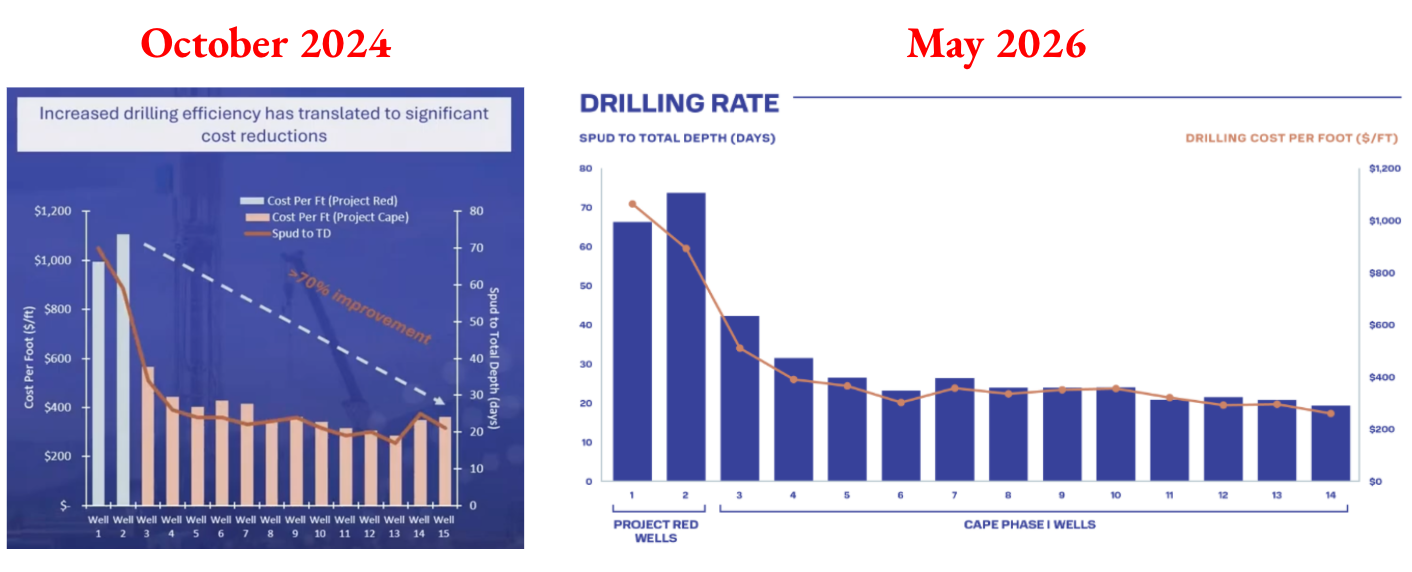
The S-1 data is inconsistent with the previously published 2024 data.
The original 2024 chart showed that Fervo’s drilling costs began to increase from Well 13 to Wells 14 and 15. The new 2026 chart had a different trend, showing a decrease in cost per foot from Well 13 to Well 14 and omitted Well 15 entirely.
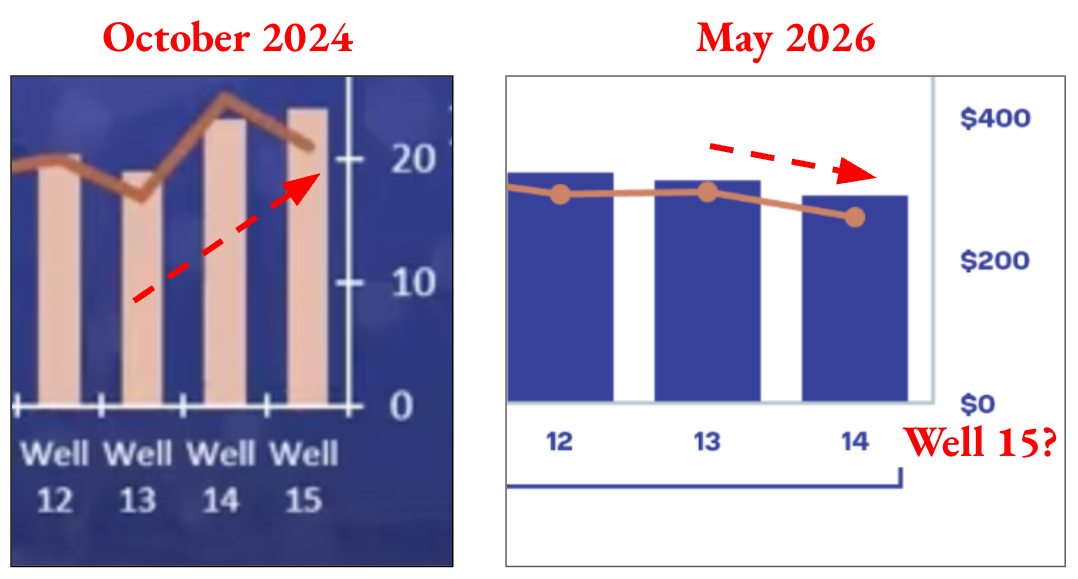
We question whether Fervo has truly made any advancements in drilling cost reduction since the initial advancements at its first few wells. While management could easily disclose these figures, Fervo declined to answer a direct question on drilling costs during its Q1 earnings call.
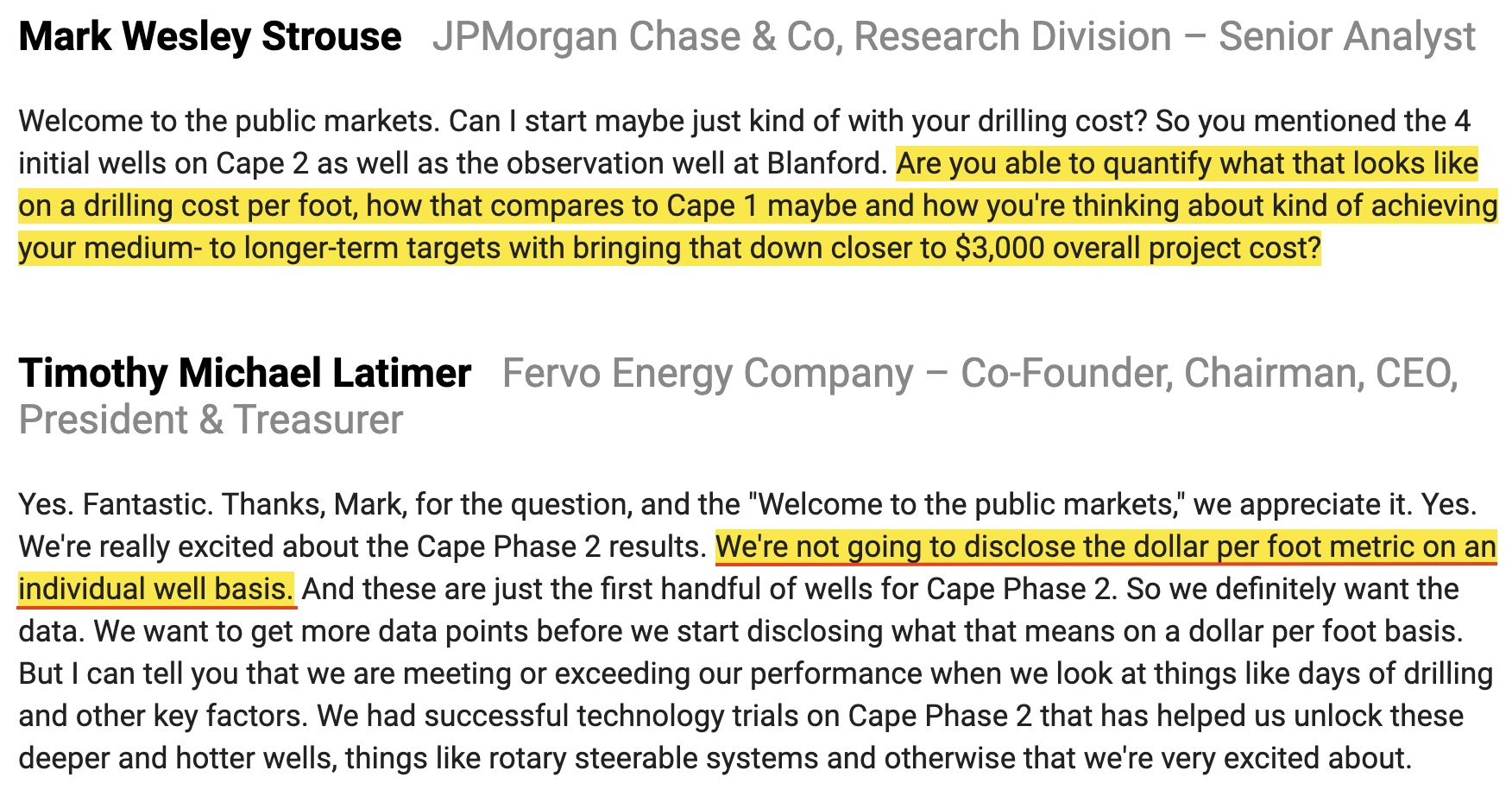
An EGS expert from Project FORGE told us that Fervo may be hitting a plateau on drilling advancements.
“There's a point in drilling where drilling faster isn't the right answer, because then you get low quality of construction … I don't think that that is as big of a lever anymore at drilling. I don't think getting drilling costs down with existing technology … you're very close to the plateau … there's a point where you damage the quality of your drill with trying to go too fast, and I think they're probably getting very close to that mark.”
While Fervo Has Been Vocal About Drilling Costs Until Recently, It Has Said Little About “Completions,” Which Former Employees Described As Fervo’s Single Biggest Cost And A “Hidden Problem”
“I Think That Something That Continues To Kind Of Make Me Flinch, Every Time I Hear Tim Talk, Is He Keeps Touting Drilling Costs … Completions Is The Bigger Cost … That’s Fracking … That’s The 300-Pound Gorilla In The Room, Is Fracking” – Former Fervo Employee
According to CEO Latimer, the “rule of thumb” in his business is that about 50% of capex goes into “drilling and completions of the wells” and 50% goes into power plant and power delivery. [19:50]
While Fervo has, until recently, been both vocal and bullish about its ability to reduce drilling costs, which normally include site preparation and rig mobilizations, it has been quieter about its ability to reduce the other significant cost driver – completion costs, which typically include casing and hydraulic fracturing.
A former employee described completions as just one of Fervo’s “hidden problems,” saying that they are significantly harder to reduce than drilling costs.
“The frack costs more than the drilling … it’s really hard to make advancements in frack like you can in drilling. Drilling, you can drill faster … but fracturing is more a function of just the time putting away that fluid and creating the reservoir. It takes time to do that, and so it’s a lot more difficult to drive down frack costs than it is drilling costs. And so that’s one of their, unfortunately that’s one of their hidden problems.”
The former employee estimated that completions cost $3,000 per kilowatt hour, equivalent to Fervo’s entire CapEx cost target and higher than what one would expect from Tim Latimer’s “rule of thumb.”
“Generally, the way we look at it, of the $7,000 per kilowatt, $2,000 of that $7,000 is the plant. The generation. The air coolers, the heat exchanges, the turbines, the production pipelines to get the water to the plant. That’s about $2,000. Drilling is roughly about $2,000 as well. And then frack [completions] is about $3,000.”
“I would be looking for them to provide some more concrete cost numbers. And what their costs are actually doing, especially on the completion side, because that’s going to be a true indicator of whether they can get down to that $5,500 per kilowatt.”
We interviewed a second individual familiar with Fervo’s operations who corroborated this perspective, and who also noted Fervo’s lack of focus on this critical metric, which they referred to as the “300-lb gorilla.”
“I think something that continues to kind of make me flinch every time I hear Tim talk, is he keeps touting drilling costs … From my experience, the drilling costs are the smaller fraction of the total number… Completions is the bigger cost… that’s fracking… so that’s the 300-lb gorilla in the room, is fracking.”
“You hear like the investment community, for instance, here's a lot of, oh, we're really reducing drilling costs, drilling costs, drilling costs, but nobody's asking what's the what about completion costs?”
Despite the apparent importance of completion costs, the expert noted that Fervo has not provided sufficient guidance on how it plans to reduce the cost of completions.
Former Employee: “I have not heard a single peep from anybody at Fervo about how they plan to do that because that truly is the biggest piece of the pie, of that $5,000 or $5,500 per kilowatt number.”
Interviewer: “Because fracking alone would potentially exceed $3,000?”
Former Employee: “Absolutely. You, bingo, you hit the nail on the head.”
We Believe Fervo Entered Into $7.2 Billion+ of PPA Agreements Before Proving Its Technology At Scale, Setting It Up For Substantial Performance-Related Penalties And Potential Commercial And Credit Defaults
“You Look At What Nikola Did, Signing Big Contracts … And They Hadn’t Even Put A Truck Out Yet … In Some Regards, This Is The Same Way. Those PPAs … They Have Fairly Significant Underperformance Penalties” — Former Fervo Employee
While Fervo claims its technology is proven at scale, we believe it faces substantial execution challenges, more than one of which could be existential to the business.
Despite facing these unsolved challenges, Fervo has already entered into 1,000+ MW of PPAs with counterparties such as Shell Energy, Southern California Edison, and Google. While investors see these PPAs as validation of Fervo’s approach, they can quickly turn into significant liabilities if Fervo fails to deliver contractually-obligated power in the required time frames, according to Fervo’s S-1.
If Fervo is just 6-months late to launch under any particular agreement its customers can cancel their agreements entirely.
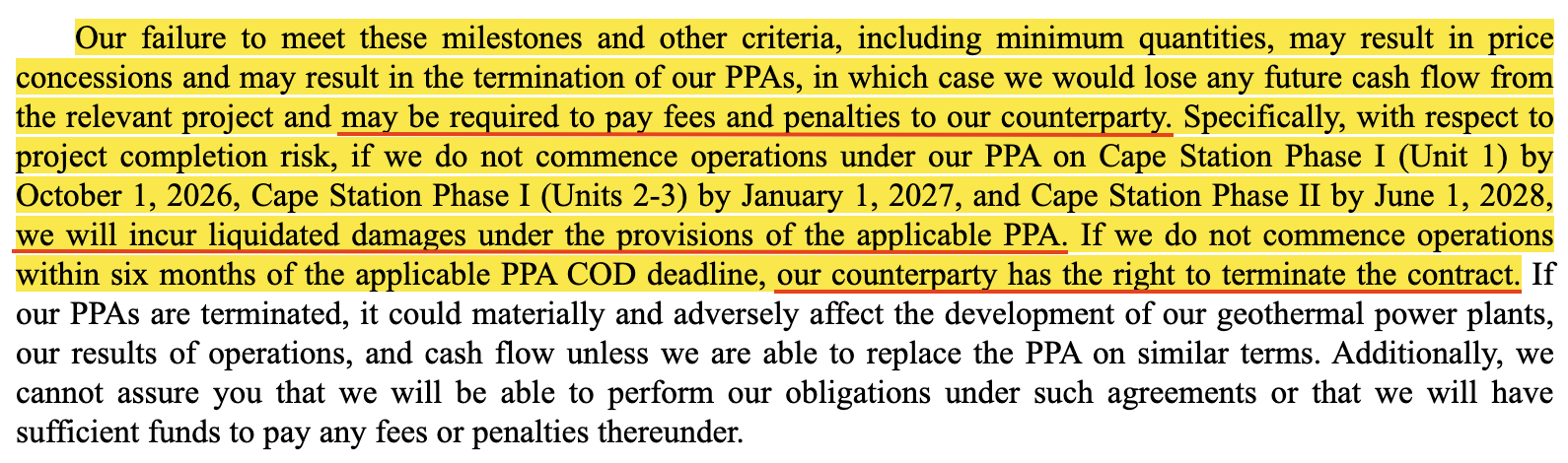
A former Fervo employee thought that entering into these PPAs was Fervo’s “biggest mistake” and compared Fervo’s commercial strategy to Nikola, a notorious “clean tech” blow-up that failed to deliver on any of its projections.
"Huge risk. Huge risk. And this, I think this is one of their, in my humble opinion, one of the biggest mistakes they made, was signing up 300 megawatt PPAs with SoCalEdison before having any commercial production online… it’s great to have a PPA and have interest in your product, but that has to be balanced with the ability to deliver …
You look at Nikola, what Nikola did, signing big contracts with companies to deliver all these trucks and they hadn't even put a truck out yet. And, in some regards, this is the same way."
The former employee explained that traditional PPAs have “fairly significant” penalties.
“Those PPAs, at least the PPAs that I’ve seen and I’ve been privy to on traditional geothermal plants, they have fairly significant underperformance penalties. And they’re not very flexible in terms of force majeure, they’re not flexible in terms of downtime… For Fervo, I think that’s a huge risk at this point because they have zero megawatts in production. They’ve got 658MW of PPAs … that’s gonna be pretty substantial underperformance penalties if they can’t deliver.”
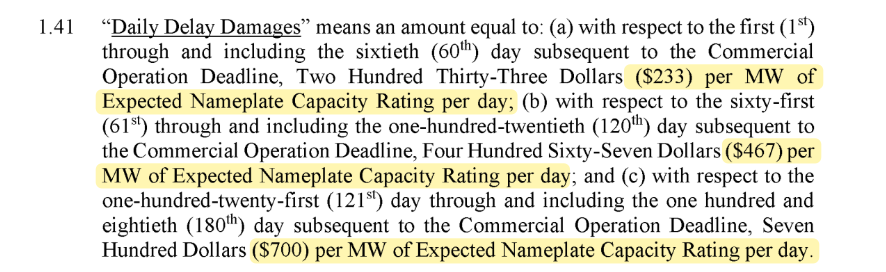
The former employee’s comments were corroborated by Fervo’s PPA with NV Energy/Google, which we obtained from the Public Utilities Commission of Nevada. The agreement includes “daily delay damages” that add to more than half a million per week if the operations are delayed by more than 121 days, and is fully cancellable if the delay exceeds 180 days.[1]
PPA found in Docket 24-05041, original filing volume 26, Public Utilities Commission of Nevada. (Pgs. 11, 87) ↩︎
Also, under the PPAs Fervo is required to deliver a certain annual output of power. Failing to deliver certain megawatts at certain reliability levels might result in the termination of a PPA, per Fervo’s quarterly report.
For example, Fervo’s agreement with NV Energy/Google assumed a capacity factor of 86.6%, expecting Fervo to deliver 872,140 MWh annually on nameplate capacity of 115 MW.[1]
Google / NV Energy capacity factor = 872,140 MWh per year / (115 MW * 8,760 hours per year). ↩︎
But the failure on Fervo’s part to deliver 80% of that expected power over a 2-year period would trigger a default event. [Pgs. 29, 87, 117]
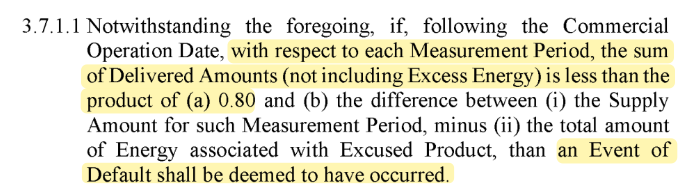
Similarly, based on the Google/NV Energy PPA, Fervo will trigger a default event if it operates at less than ~70% of the contracted capacity. This might turn out to be problematic for Fervo, since its own pilot plant operated at less than 50% of its nameplate capacity, according to our analysis of Fervo public statements.[1]
Measurement Period is defined as “each two (2) years consecutive Contract Years.” (Pg. 16) Supply Amount is 872,140 MWh and is stated in Exhibit 13 (Pgs. 22, 117). Excused Product, represents the power not delivered due to legitimate reasons (Pgs. 13, 30). 80% of Supply Amount is 697,712 MWh per year, equivalent to 69.26% of the power capacity that 115 MW can generate over a year.Fervo claims that its pilot plant has 3 MW capacity, per its latest prospectus. According to results published by Fervo, where they claimed that its technology was “proven at scale,” the company disclosed that the average net output during 614 days was 1.4 MW, resulting in less than 50% of its installed capacity. ↩︎
Overall, if Fervo underperforms under its PPAs agreements they could trigger the termination of the contracts and a possible Event of Default under Fervo credit agreements.[1]
Fervo’s project finance for Cape Station, considers that an Event of Default in a Material Project Document, including PPAs, is considered an Event of Default under the credit agreement. ↩︎
Fervo Claimed In Its Prospectus That It Had ~290MW Of Interconnection And Transmission Rights For Its Cape Station Phase II, Which Was Supposed To Supply Power To Clients In California By 2028
Reality Check: Fervo’s California Transmission Pathway Is Being Retired In June 2027, And In April Fervo Told California’s Grid Operator That There Would Be “No Viable Pathway For Utah Geothermal To Contribute To California’s Grid Before 2032” Unless The Operator Delivered New Solutions
Fervo Has Now Pushed Its Guidance For Power Delivery To Its California Clients To a Vague “2030+” Date
Even if Fervo somehow conquers the many structural challenges detailed in this report, we believe it is facing yet another existential risk related to transmission capacity and its ability to get power from Utah to its California client base.
In April 2026, Fervo commented on the California grid operator’s transmission planning process, stating that it had “no viable pathway” to deliver power to California before 2032 unless the operator developed a solution for it.
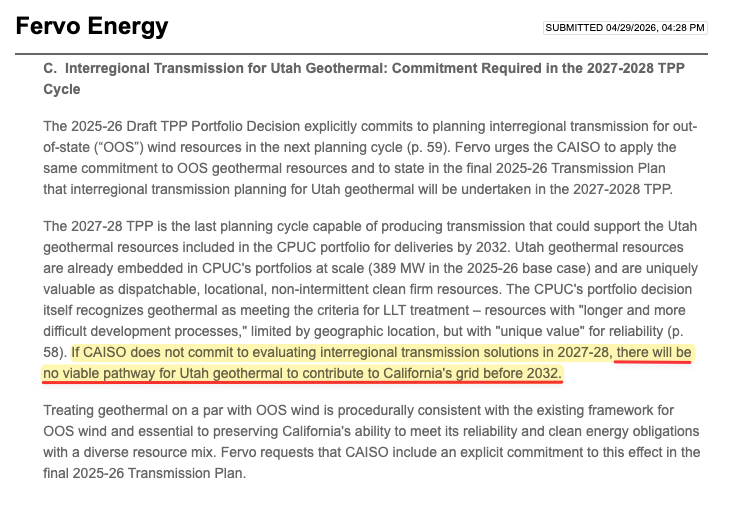
In a contradictory statement, Fervo told investors in its May 2026 prospectus that it had ~290MW of transmission capacity, specifically noting that this would allow it to serve two key California clients – Southern California Edison and Clean Power Alliance. The same filing stated that Phase 2 of Cape Station would have a Commercial Operation Date (“COD”) of 2028.
On its Q1 earnings call in June 2026, it doubled down on this claim.
Fervo CFO: “All of Cape Phase 1, which is 100 megawatts, we have the transmission fully contracted. And on Phase 2, which is 400 megawatts, we have 300 megawatts of that fully contracted and are working to close the gap there.”
Despite this admission, Fervo’s CFO downplayed transmission issues during the Q2 earnings call, stating that it is an issue that is “unique to 2027.”
The following month, however, Fervo published a blog post admitting that the “delivery picture has changed” and that the delivery pathway to California “is being retired in 2027, and available capacity on the remaining paths into California is limited.”
On that same day of this admission, Fervo announced a new PPA with Google for ~400MW— the PPA would power a Utah data center whose location had not been determined, according to The Wall Street Journal.
A company presentation published the same day implies that the new Google PPA would take the power originally planned for some California clients, which will now supposedly receive power after a vague “2030+” date. [Pg. 13]
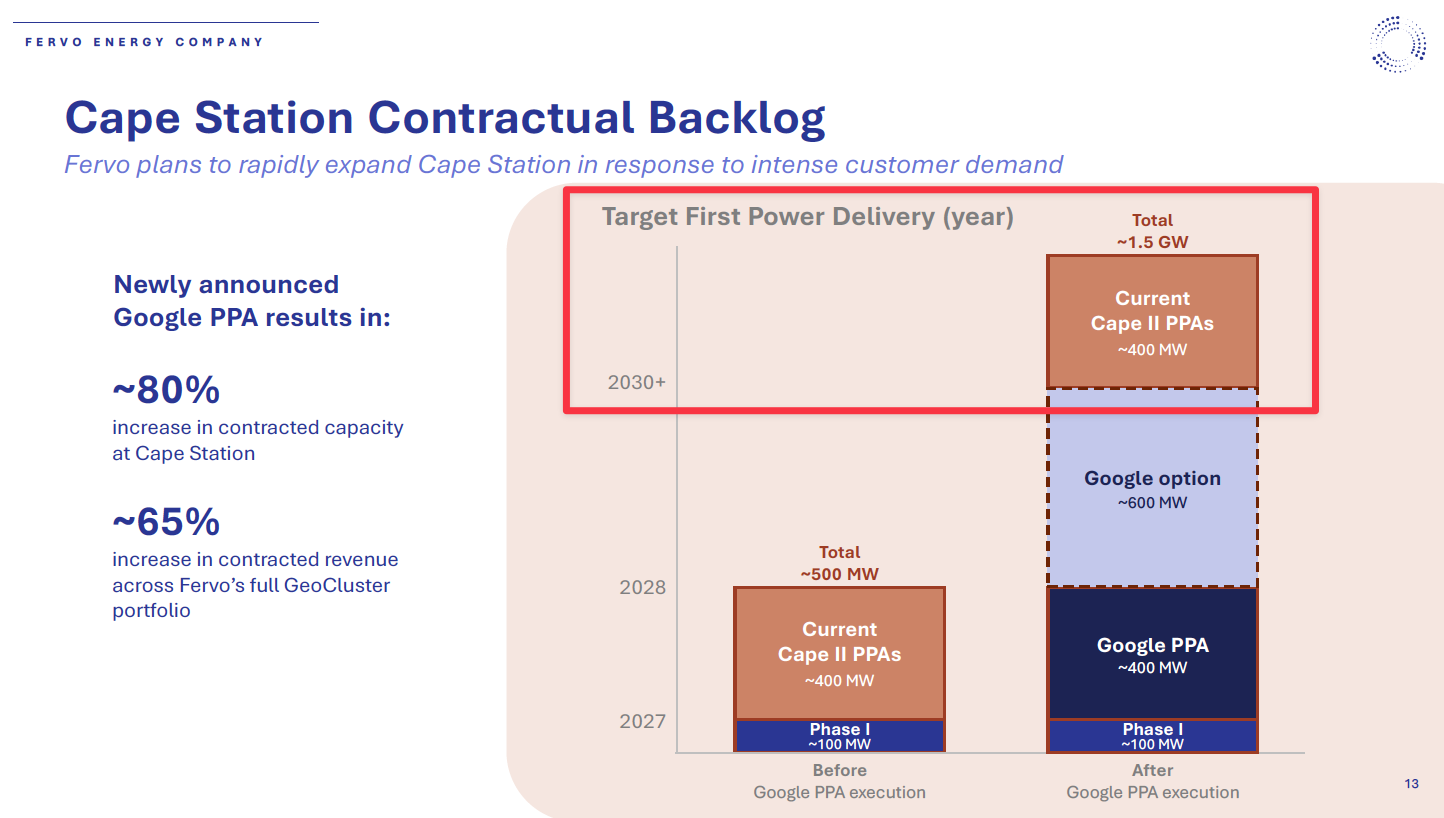
While the Google announcement was met with fervor, we believe it was an indirect admission that Fervo has no plan to get power to its California clients, which is why it has reassigned this capacity to Google for a data center that has not been defined yet, per The Wall Street Journal reporting, and for which transmission capacity may also need to be built.
Part 4: Former Employees, Industry Experts, And Fervo’s Own Data Indicate Induced Seismicity Is Accelerating, Already Damaging Equipment, And Causing Unpredictable Water Losses
Background: Increased Seismic Activity In Small EGS Projects Has Led To Multiple Cancellations After Capex Has Been Deployed
In the past, hydraulic fracturing has correlated with increased seismic activity. This seismic activity can lead to damaged well casing and exacerbated water loss, both of which can lead to devastating project delays and unexpected costs, according to our interviews with EGS industry experts.
In some cases, EGS fracturing has led to full blown earthquakes. Two widely known examples of this are from EGS projects in Basel, Switzerland and Pohang, South Korea, where induced seismic events led to surface damage and the shutdown of EGS projects.
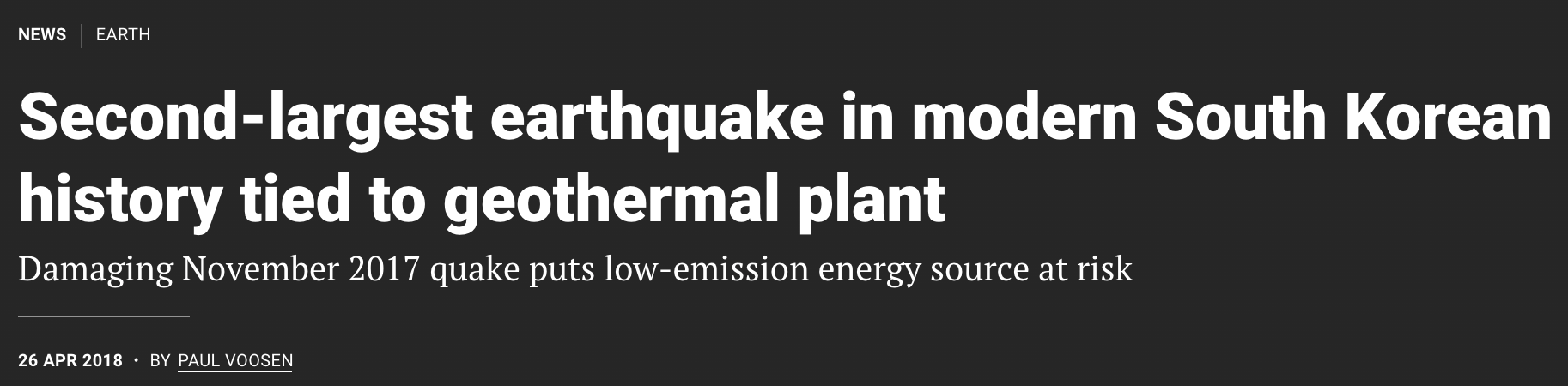
Fervo’s Cape Station project is orders of magnitude larger than Basel and Pohang combined, and critics like energy analytics firm Enverus have called seismicity a “potential project killer” as Fervo attempts to scale an EGS system at a capacity that is orders of magnitude higher than those of Basel and Pohang.[1]
“Induced seismicity in EGS follows the same mechanism as saltwater disposal in shale. High-pressure fluid injection reduces the effective stress on existing faults, thereby reactivating slip along these planes … EGS injects at greater depth into basement granite, where faults are less mapped and fault displacement can release more energy per event. “ [Enverus]
“No EGS project has managed seismicity across hundreds of injection wells at gigawatt scale, and a regulatory shut-in after most capex is deployed is yet another high-consequence risk in the portfolio.” [Enverus]
CEO Latimer Has Described Seismic Risks As A “Perception Issue” And Stated That Fervo Has Only Experienced “Several” Yellow Level Seismic Events Over 4 Years Of Operations
Reality Check: Fervo’s Cape Station Site Has Experienced At Least ~58 Yellow Level Seismic Events According To Its Published Seismic Catalogue, Which Rapidly Accelerated In Frequency And Intensity As Fervo Fracked Its Deepest Wells Yet In April 2026
An EGS Expert From Project FORGE Told Us: “It’s Very Much A Risk, And Their Seismicity Has Been Growing Downward Substantially, So The Deeper You Go, The More Likely You Are To Trigger A Large Earthquake” And Told Us They Were “Aghast” That Fervo Is Not More Concerned
According to Fervo’s website, it operates a “traffic light” protocol where it pauses operations for at least 6 hours for “amber” (i.e, yellow) events (Richter scale 2.0+ magnitude) with more extended pauses of 24 hours and additional measures for “red” events (Richter scale 3.0+ magnitude).
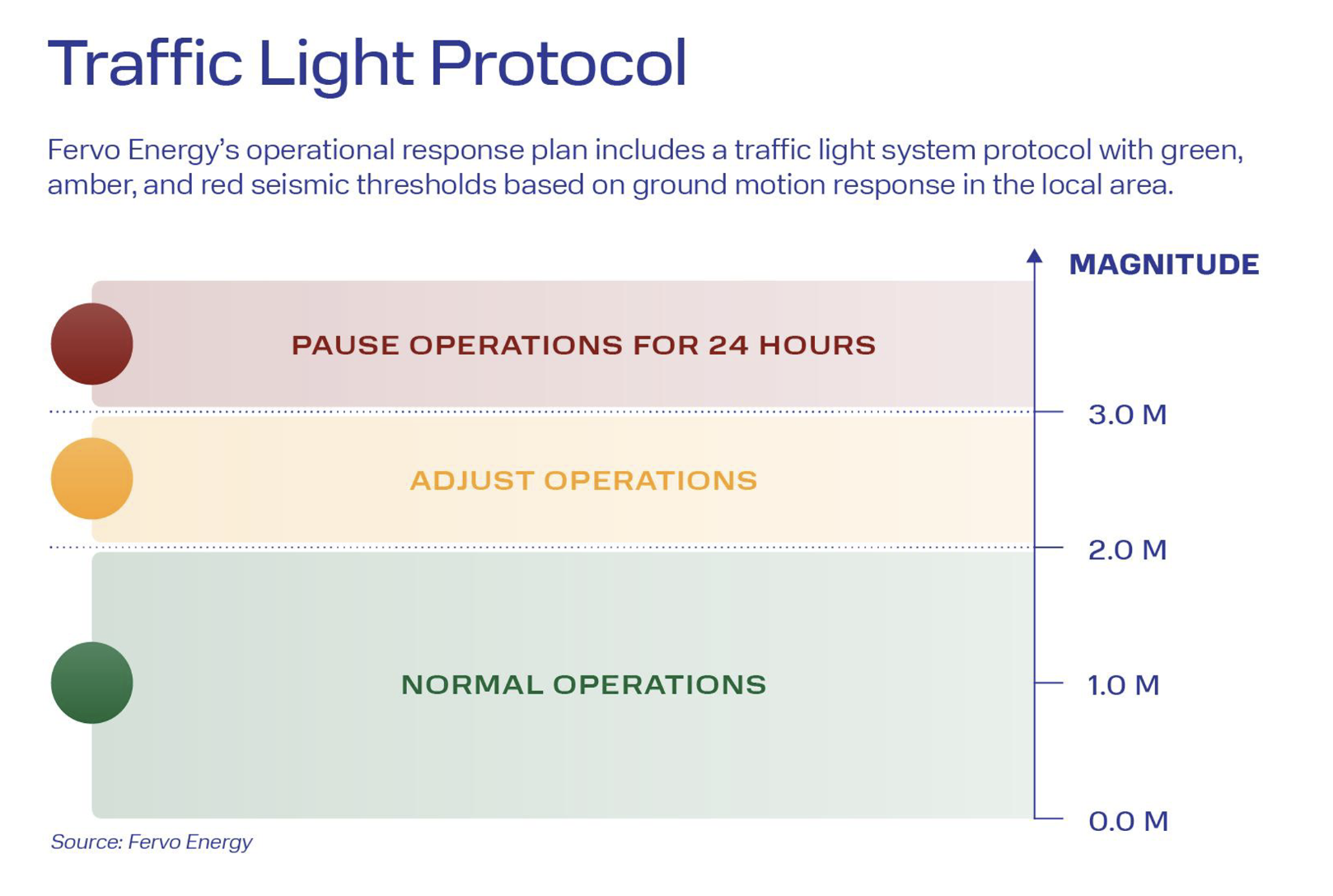
During a July 2026 interview, CEO Latimer was asked directly about seismicity. He referred to it as a “perception issue” in geothermal, around which Fervo has supposedly adopted a policy of “radical transparency.” Specifically, he claimed that the company has only observed “several” yellow level (Richter 2.0 M to 2.9 M) events over four years of Cape Station operations. [48:30, 52:20]
Fervo’s own blog post, published weeks after this interview, conceded 36 yellow-level seismic events from November 2025 to April 2026 – which is, in our view, far higher than the “several” disclosed by Latimer.
Further, we extracted and analyzed all of Fervo’s seismic events from February 2024 to April 2026 from the company-hosted catalogue, and found a total of 58 yellow-level seismic events over the last 2 years. These appear to have spiked in March and April, around the time that Fervo was simultaneously fracking 6 wells on its Frisco pad, per its Q1 earnings call.[1]
Fervo publishes an interactive map with Cape Station project seismic activity. On August 3, 2026, using a script we were able to identify close to 40,000 seismic events from this website available on a layer described as “Cape_Seismic_Events” hosted on the platform that powers the interactive map. The data set’s last recorded seismic activity was as of April 21, 2026. ↩︎
While Fervo describes the stimulation of the Frisco pad as “successful,” it failed to say anything about the spike in seismic activity, despite its stated core value of “radical transparency.” As we demonstrate below, the seismic events are accelerating in both frequency and intensity.[1]
In its latest seismic insights report published in June 2026, the company acknowledged 36 yellow events, from November 2025 to April 2026. This number matches the number of yellow events obtained in our data set. ↩︎
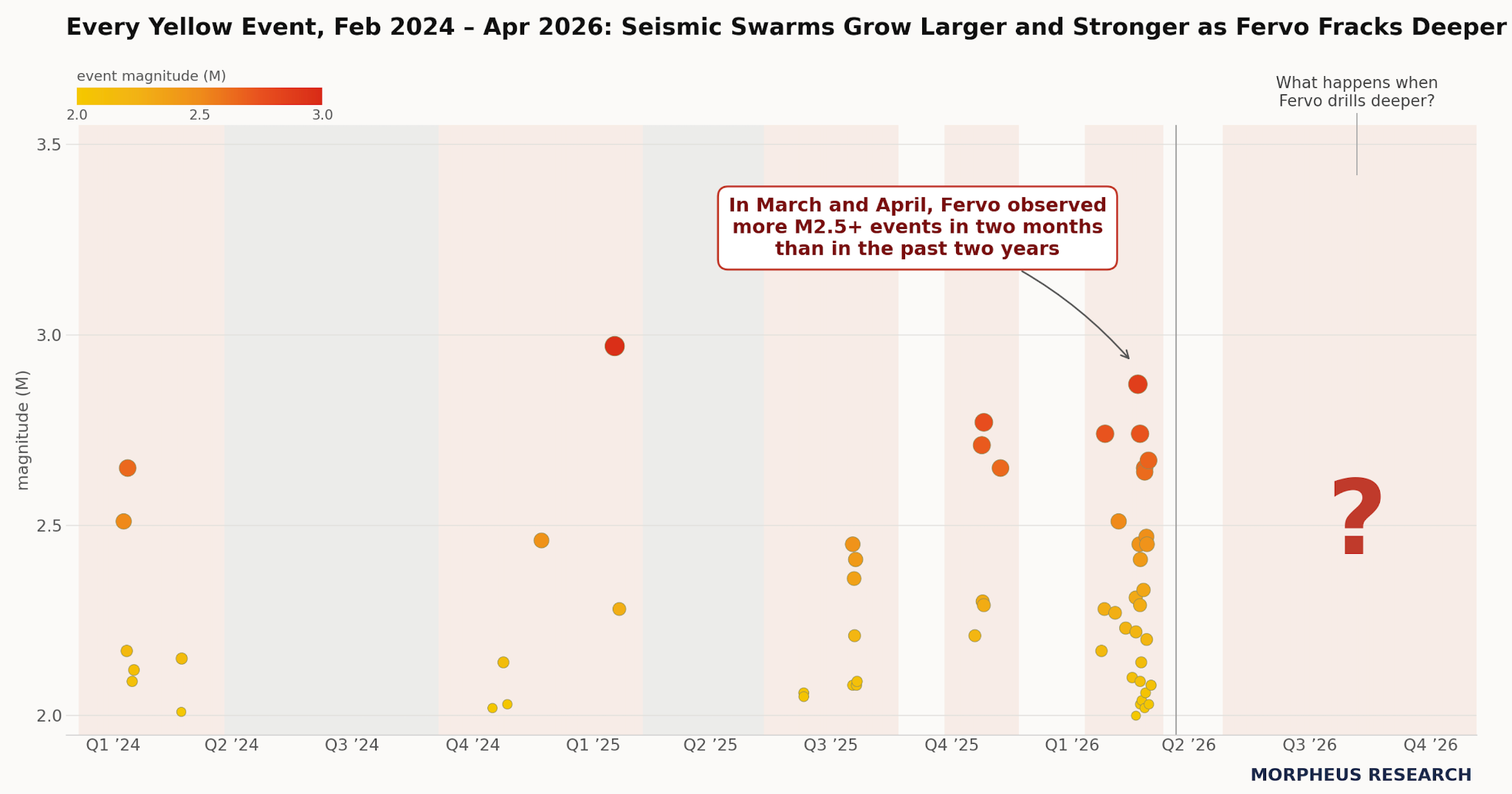
Fervo plans to drill deeper into the earth and conduct fracking operations at greater and greater scale throughout time, including at its Kings pad, which it stated on its Q1 earnings call was ready to be fracked.
Fervo has not published any seismic data after April 2026, and is expected to publish its next semiannual seismic report in the next month or two, per its guidance of updating every 6 months.
Fervo’s Published Seismic Activity Catalogue Only Includes Data Through April 2026, But We Obtained More Recent Data From The US Geological Survey Indicating That Fervo’s Seismicity Has Accelerated Even More, To 39 “Yellow Level” Seismic Events In The Last 30 Days Alone
24 Days Ago, The First “Red Level” 3.1 Magnitude Earthquake Occurred At Fervo’s Cape Station Project, The Largest In Fervo’s History, Likely Triggering A Minimum 24-Hour Pause, Per The Company’s Safety Protocols
We believe the data published in Fervo’s seismic activity catalog is extremely concerning, but this catalogue only includes seismic activity through April 2026. To find more recent evidence of seismic activity, we went directly to the US Geological Survey’s seismicity tracker and found that seismicity has continued to accelerate in both frequency and intensity since April 2026.
For example, in the 30-day period from August 26 to September 25, there have been 39 seismic events around Fervo’s Cape Station site that registered at 2 or higher on the Richter scale, according to the US Geological Survey’s seismicity tracker. This 30-day activity represents 67% of the total yellow events we found in the company catalogue we previously cited.
24 days ago, a magnitude 3.1 earthquake occurred at Fervo’s Cape Station site, the largest in Fervo’s history and its first “red level” event.[1]
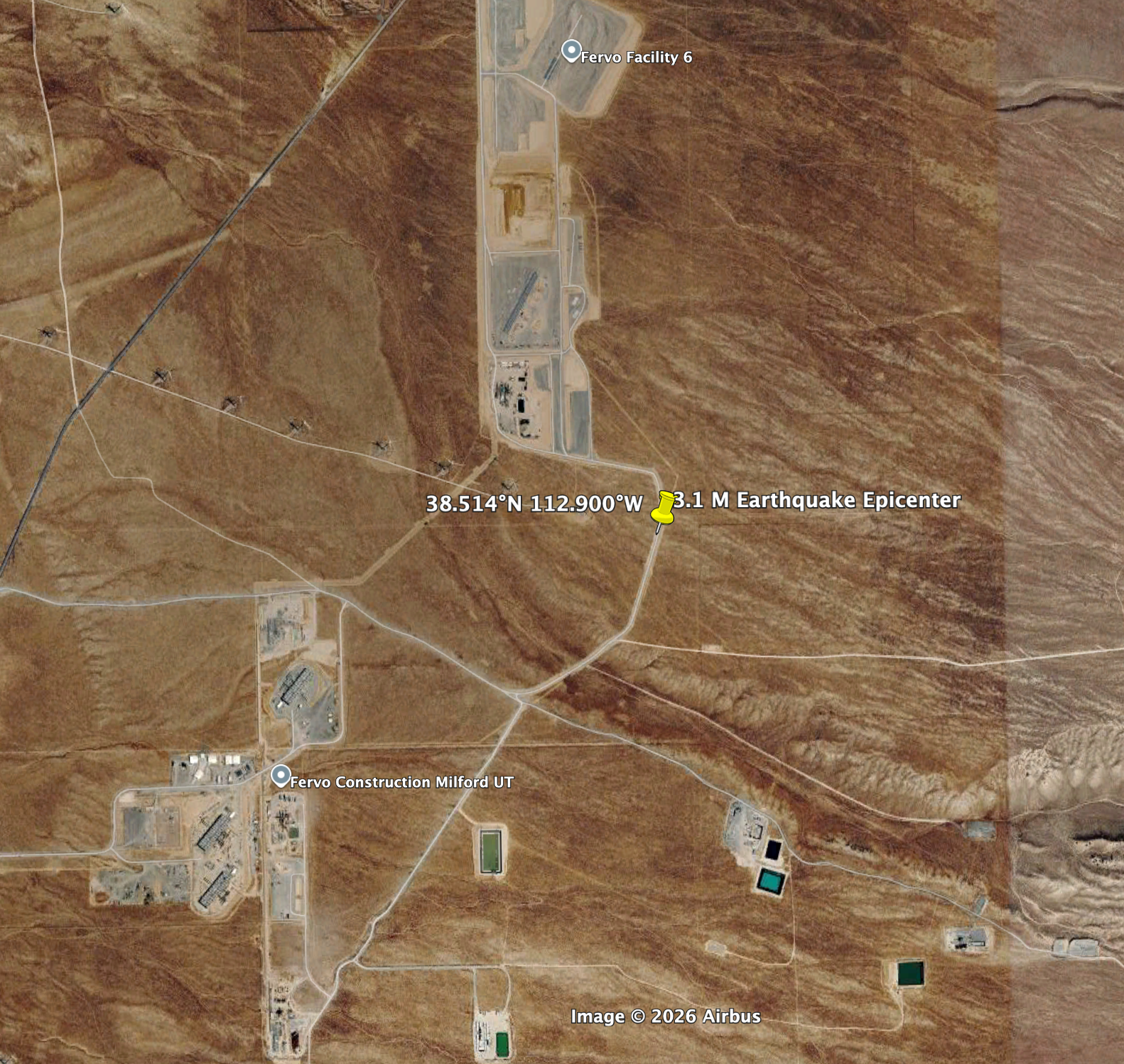
According to Fervo’s “traffic light protocol,” this event should have triggered a complete operational shutdown for at least 24 hours and triggered outreach to local stakeholders and regulators. As far as we can tell, however, Fervo has not yet publicly acknowledged the earthquake.
CEO Latimer Claims Seismicity Has Not Led To “Any Risk” Or “Any Significant Alterations” In Operations
Reality Check: Fervo Is Already Experiencing Damage To Well Casing And Accelerating Water Loss Due To Seismicity, But Has Stayed Silent, According To Former Fervo Employees
Former Fervo Employee Told Us About “The Major Problems That Fervo Is Seeing Right Now [Are] With Casing Failures. Those Casing Failures Are Happening Because Of Earthquakes/Seismicity”
During the July 2026 interview, CEO Latimer claimed that the observed seismic activity to date has been minor and has not presented risk to equipment or affected operations.
“We’ve not observed any seismicity that has had to, that has had to, that has caused any risk or had us to take any significant alterations in the operations.” [52:25]
A former employee, however, disagreed with this, saying that Fervo is already having a “major problem” with seismic events destroying the metal pipes, known as casing, in its Cape Station wells.
“... the major problems that Fervo is seeing right now [are] with casing failures. Those casing failures are happening because of earthquakes/seismicity …
The major problem that Fervo is running into, the fluid gets saturated in the rock, it has no place else to go, it starts working against the tubulars, the metal pipes that we have drilled into this rock, and it starts to puncture those tubes, deform the tubes. That’s a major problem that Fervo is dealing with, and nobody likes to talk about it...”
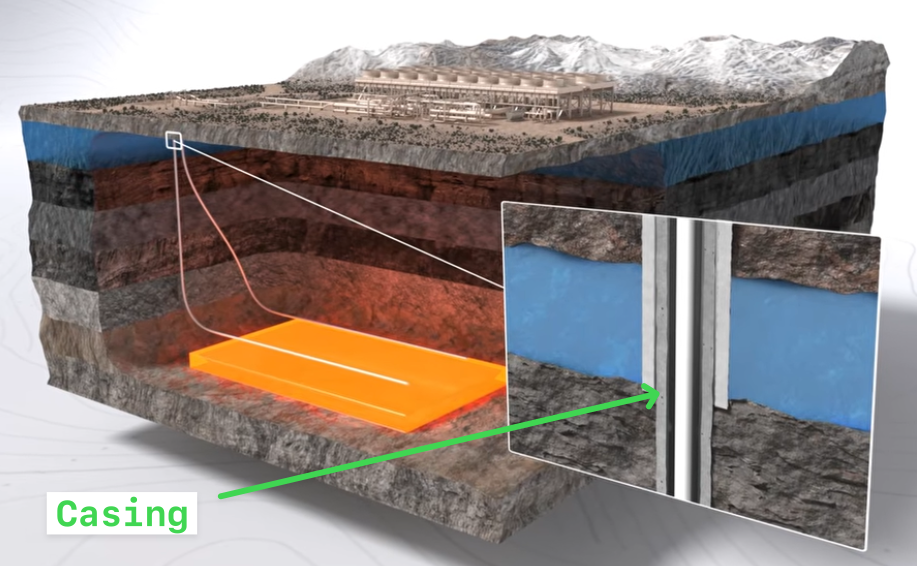
The former employee explained that seismicity is also exacerbating water loss due to the opening of pathways to fault systems.
“... when we try to put more fracture volume into these rocks, and that's what was done at Cape Station, we hit deep-seated faults. And the direct result was, when we tried to increase the injection pressure and injection rate, we saw immediate effect with these volumes not reacting the same way on the producer well, and much higher loss ratio, because we were just feeding the fault instead of feeding the producer well … and the main problem is, once you create that path for it to, you know, flow, directly into the reservoir, you never recover that volume.”
We interviewed a geothermal expert affiliated with the nearby FORGE project, who told us that Fervo’s seismic activity has been accelerating and that they were “aghast” that Fervo was not more concerned about seismic activity.
“It’s very much a risk, and their seismicity has been growing downward substantially. So the deeper you go, the more likely you are to trigger a large earthquake… You have a real chance of lubricating a structure that’ll slip.”
“If their fracture networks are growing down 5,000 feet from their laterals and sort of lighting up these lineaments, I think that should be a cause for concern for them. And I’m sort of aghast that they don’t seem more concerned. Maybe they are internally.”
If seismicity continues to accelerate, we believe Fervo will face immense and ongoing repair and remediation costs, while the threat of an existential-level seismic event becomes more and more likely.
Conclusion & Questions For Management
Fervo CEO Tim Latimer has called skeptics “keyboard warriors” while relentlessly touting Fervo’s approach as proven, derisked, and cost-competitive. We believe these claims are clearly false. In reality, Fervo faces the same unsolved technical barriers that have crushed decades of attempts to commercialize EGS, but management is actively concealing this reality from shareholders.
In the coming months, Fervo plans to pour $1.2 billion of shareholder capital into assets that we believe are fundamentally unviable. We believe that any remaining cash will be incinerated by deep operating losses, substantial customer penalties, and possible shareholder lawsuits. The reality of Fervo’s situation will become increasingly apparent to the market just as the company’s IPO lock-up expires on November 10.
To give Fervo the chance to practice the “radical transparency” that it preaches, we have compiled the following questions:
- In September 2024, you published a paper showing consistent production temperatures over 10+ months of pilot plant operations. This paper conflicts with data reported to the Nevada Division of Minerals, which reveals significant monthly temperature fluctuations of up to 90°F from February 2024 to August 2024. How do you explain this discrepancy? Why did you claim in your registration statement that the pilot plant exhibited “consistent, stable temperature output”?
- You stated in your S-1 that the pilot plant “has not experienced the kind of premature thermal decline that has long plagued traditional geothermal projects.” This claim conflicts with data reported to the Nevada Division of Minerals that reveals an annualized thermal decline rate of 24°F from November 2025 to May 2026 . Why did you make this statement, and would you now agree that the pilot plant is exhibiting rapid and premature thermal decline?
- You disclosed that early flow tests at your pilot plant resulted in 10-20% water losses, and CEO Latimer claimed this would “only decline from there.” Water losses more than doubled, and you retroactively claimed that you predicted this. Why did you say this was predicted when you are on the record predicting the opposite?
- You have stated that water loss at the pilot plant is “temporary” as the reservoir “pressurizes,” yet water losses have climbed to 35% as of June 2026, according to data from the State of Nevada. When do you expect this “pressurization” to actually happen and what evidence can you offer investors to justify that claim?
- In September 2024, you announced “record-breaking production results” from a Cape Station flow test as the “Frisco” pad. Despite carrying out this test over 30 days, you only released 24 hours of power production data, omitting key operating metrics such as water loss. A former employee told us you were worried if you showed the full data that “will put a lot of questions in the market in terms of viability… the results weren’t as good.” Why would a former employee say this? Will you now share the full data and key operating metrics like water loss from that flow test?
- In 2024, you stated your CapEx per kW was $5,000. In 2025, it increased to $6,000. Today, it has increased to $7,000 but you continue to tell investors that $3,000 is “firmly in view.” Will you quantify the inputs, including the cost of drilling, completions and power equipment, to your $7,000 figure and explain how exactly you intend to reach $3,000?
- ResFrac modeled a sub-1% water loss rate for Cape Station. Yet a former employee told us that the rock structure is less favorable for water loss than the pilot plant and water losses are going to be “massive.” In terms of CapEx, OpEx, and water-related capacity limitations, how will your business be impacted if you are unable to achieve the sub-1% water loss rates modeled by ResFrac? For example, at 5%, 10%, and 15% water loss rates?
- Cape Station’s water access is contingent on a “non-consumptive” designation, based on the theory that any “leak off water” will migrate back to the original aquifer. Local stakeholders, industry experts, and your own former employees have disagreed with this theory. One former employee told us “there is no data behind it, and that’s what worries me.” What real-world evidence do you have to support this, and what does it mean for Cape Station if this theory does not work in the real world? If your use ends up being reclassified as consumptive, what is your back-up plan to source make-up water?
- We found significant differences in the data the company presented on drilling costs at a University of Houston Conference in 2024 and in your own S-1 in 2026. It appears that data on drilling costs may have been altered between October 2024 and April 2026. How do you explain this discrepancy? Why did you leave out Well 15 from the chart in your S-1? How has your drilling cost-per-foot evolved over the last 3 years and what is it currently?
- A former employee told us: “the major problems that Fervo is seeing right now [are] with casing failures. Those casing failures are happening because of earthquakes/seismicity.” CEO Latimer has said publicly that seismicity is a “perception issue” that has not impacted operations. Have you seen damage to well casing or other equipment from seismic activity, and will you quantify the costs and project delays caused by this seismic activity? Is seismic activity exacerbating water losses?
Disclosure: We Are Short Shares of Fervo Energy Company (NASDAQ: FRVO)
Legal Disclaimer
Use of Morpheus Research LLC’s (“Morpheus Research”) research is at your own risk. In no event should Morpheus Research or any affiliated party be liable for any direct or indirect trading losses caused by any information in this report. You further agree to do your own research and due diligence, consult your own financial, legal, and tax advisors before making any investment decision with respect to transacting in any securities covered herein. You should assume that as of the publication date of any short-biased report or letter, Morpheus Research (possibly along with or through our members, partners, affiliates, employees, and/or consultants) will have a position in the stock, bonds, derivatives, or securities covered herein and, therefore, stands to realize significant gains if the price of the securities move. Morpheus Research also frequently enters into arrangement with capital providers pursuant to which those capital providers establish positions in a target company. Morpheus does not make any recommendations to, or control or otherwise influence trading by, such capital providers. Following publication of any report or letter, Morpheus Research intends to continue transacting in the securities covered therein and may be long, short, or neutral at any time thereafter regardless of Morpheus Research’s initial position or views. Morpheus Research’s investments are subject to its risk management guidance, which may result in the de-risking of some or all its positions at any time following publication of any report or letter depending on security-specific, market or other relevant conditions. You should assume that as of the time you read this report, Morpheus Research has covered or closed some or all of its initial positions at the time of publication. This is neither an offer to sell or a solicitation of an offer to buy any security, nor shall any security be offered or sold to any person, in any jurisdiction in which such offer would be unlawful under the securities laws of such jurisdiction. Morpheus Research is neither registered as an investment advisor in the United States, nor does it have similar registration in any other jurisdiction. To the best of Morpheus Research’s ability and belief, all information contained herein is accurate and reliable and has been obtained from public sources believed to be accurate and reliable, and who are not insiders or connected persons of the stock covered herein or who may otherwise owe any fiduciary duty or duty of confidentiality to the issuer. Conclusions expressed herein are based upon the information disclosed herein and represent the opinion of Morpheus Research. Such information is presented “as is,” without warranty of any kind – whether express or implied. This report was prepared independently, without coordination with any third party. Morpheus Research makes no representation, express or implied, as to the accuracy, timeliness, or completeness of any such information or with regard to the results to be obtained from its use. All expressions of opinion are subject to change without notice, and Morpheus Research does not undertake to update or supplement this report or any of the information contained.